The evening enquiry
It arrives at 21:40 and gets read at 08:30 the next day. In between the person wrote to two others, and whoever answers first has an advantage that has nothing to do with price.

Guest relations
The risk with an artificial intelligence talking to your guests is not that it answers badly. It is that it answers confidently with something false: a room that does not exist, a price you never charged, a rule you never had.
The problem
Nobody counts the answers that never went out, which is why it is the number nobody knows. They are lost in three places, and in all three the cause is the same: whoever answers is doing something else.
It arrives at 21:40 and gets read at 08:30 the next day. In between the person wrote to two others, and whoever answers first has an advantage that has nothing to do with price.
Open the PMS, check availability, work out the board arrangement, write it up. Ten minutes for an enquiry worth three hundred euros: when six arrive on a busy afternoon, two of them stay unanswered.
The quote went out and then nothing. A reminder after three days recovers a share of those enquiries — but it is work nobody does, because it is never urgent.
The difference that matters
They all get called the same thing and they do three different jobs. The distinction is not how «intelligent» they are: it is where they get their information, and what they do when they do not have it.
| Criterion | Rule-based chatbot | Generic AI assistant | Connected AI receptionist |
|---|---|---|---|
| Where rates and availability come from | Nowhere: it replies «contact us» | From whatever you pasted into a knowledge sheet | From the PMS, in real time |
| Can produce a real quote | no | no | yes |
| What it does when it does not know | Repeats the menu | ⚠️ May invent one, confidently | Hands the conversation to a person |
| Recognises a returning guest | no | no | yes |
| Follows up those who went quiet | no | If you schedule it yourself | yes |
| Who checks what was said | Nobody needs to: the answers are fixed | Nobody, unless you read the conversations | Every reply passes a check before it goes out |
⚠️ The row to read twice is the third. A generic assistant connected to nothing is the riskiest setup a hotel can have: it always answers, and sometimes it answers correctly.
The three rules
These are the conditions we hold ourselves to, and the ones worth putting to anyone selling you something in this category.
Where we come in
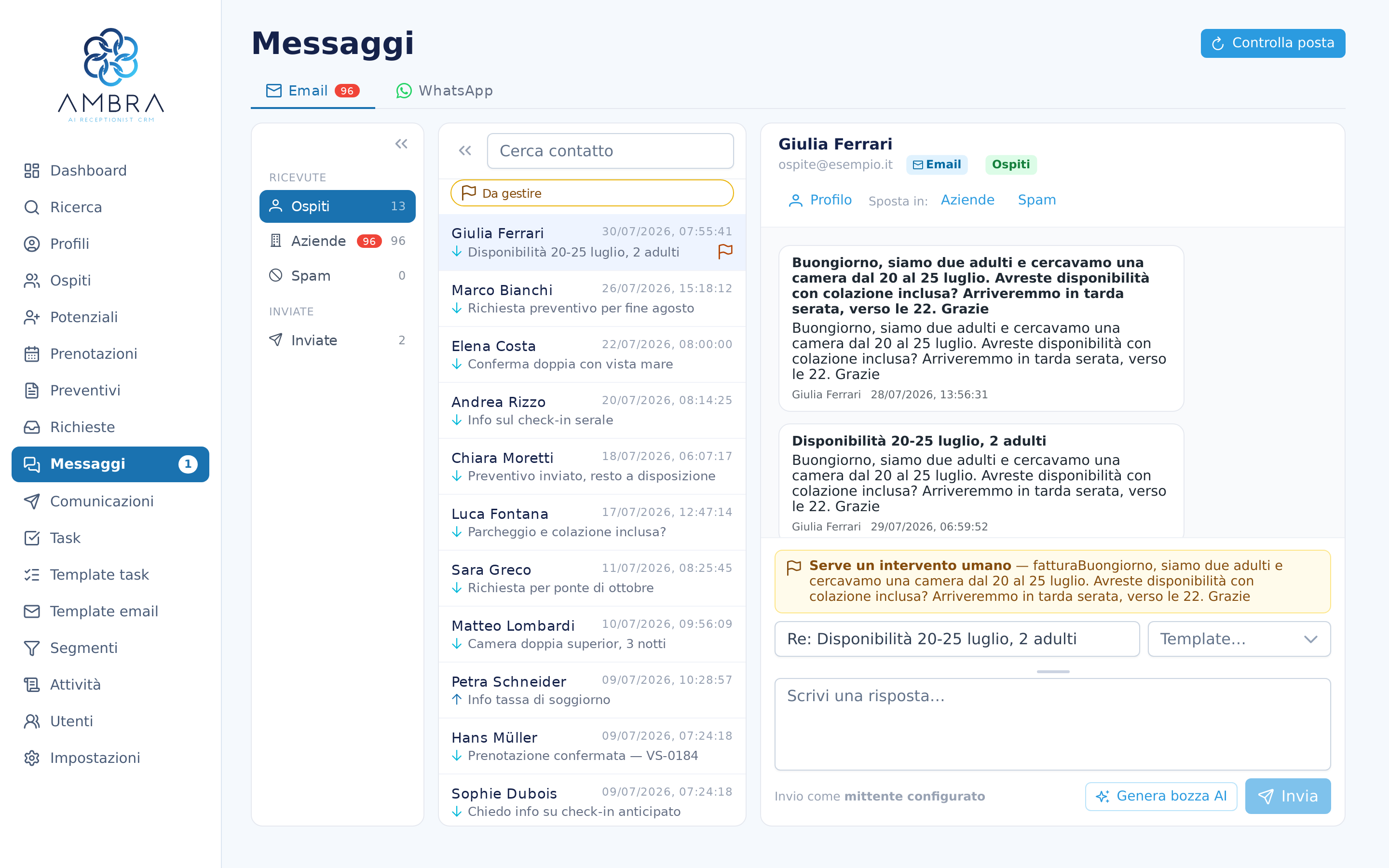
She answers enquiries by reading rates, availability and house rules from the PMS, builds quotes on real prices, and follows up the people who went quiet. The three rules above are not an intention: they are wired in — every reply passes a check before it goes out, and when it does not hold up the conversation comes to you instead of to the guest.
And when a request falls outside what she knows, she does not improvise: she hands it to a person with the context already gathered, so whoever picks it up does not start from zero. Decisions stay where they are.
By reading the conversations — all of them, for the first few weeks. It is the only way, and anyone telling you it is unnecessary is asking you to trust something that talks to your customers.
The question to put to a vendor is sharper: «can I see every conversation, search them, and know which replies were blocked by a check?». If the answer is no, it is not verifiable.
No: it moves the work. The repetitive enquiries — availability, prices, opening hours, how to get there — go to her; the ones that need a decision or a face stay with the front desk, which finally has time to do them properly.
The saving is real, it just does not arrive as one person fewer: it arrives as the enquiries that used to be lost overnight, and as the hours handed back to the people who stay. Anyone selling it to you as a headcount cut is promising the wrong thing.
The languages your guests use, and this is where AI genuinely pays: answering in German at 22:00 on a Saturday is the thing a small front desk cannot do — not «answering faster».
These are personal data and must be treated as such: a legal basis, a notice that says so, limited retention. The technical question to ask is where the messages end up and whether they are used to train somebody else's models.
For us the answer is no, and it is written in the privacy notice rather than promised out loud.
Yes, and it is the channel where the difference shows most — because it is the one where people expect an answer in minutes. It needs a number connected to Meta's official channel: it is not an app hanging off a phone in the back office.
Let Ambra answer yours, and we will look together at how she gets on — including the times she hands over.
Request a demo