The early departure
The guest in 204 leaves two days early. On the sheet it is a stayover, so the room gets a light clean — and at 15:00 somebody checks into a room that needed a full turnover.

Housekeeping
Arrivals, departures and who is staying on are already in the PMS. The day's work plan is a consequence of those three facts — and every morning, in thousands of hotels, somebody copies it out by hand from a board.
The problem
A printed sheet works perfectly at eight in the morning. The trouble arrives at eleven, when something changes — and the paper does not change with it.
The guest in 204 leaves two days early. On the sheet it is a stayover, so the room gets a light clean — and at 15:00 somebody checks into a room that needed a full turnover.
108 was free this morning and got sold at noon. If the plan lives on paper, the news travels by word of mouth — or it does not, and the room stays closed while the guest waits at the desk.
The desk calls upstairs to ask whether 305 is ready. Three times a day, across twenty rooms: half an hour of phone calls that exists only because room status is not written anywhere shared.
The choice
This is the decision that matters, and we will say it even though it does not suit us: if you already have a housekeeping app your people are happy to use, the problem is not the app — it is that it knows nothing about the bookings.
| Criterion | Printed sheet | Standalone housekeeping app | PMS module |
|---|---|---|---|
| Who prepares the day plan | A person, every morning | A person, inside the app | It builds itself from arrivals, departures and stayovers |
| Knows if a room is an arrival, a departure or a stayover | Only at the moment it was printed | no | yes |
| Updates when the booking changes | no | no | yes |
| The front desk sees status in real time | no | yes | yes |
| Linen changes following the house rules | If you remember | If you configure it by hand | yes |
| Rooms out of service for maintenance | On another sheet | Marked twice | Blocked once, and not resold |
The middle column is not useless: a dedicated app is very convenient for whoever cleans. The point is that somebody still has to fill the plan in, and that somebody re-reads the board — which is the work you were trying to remove.
Where we come in
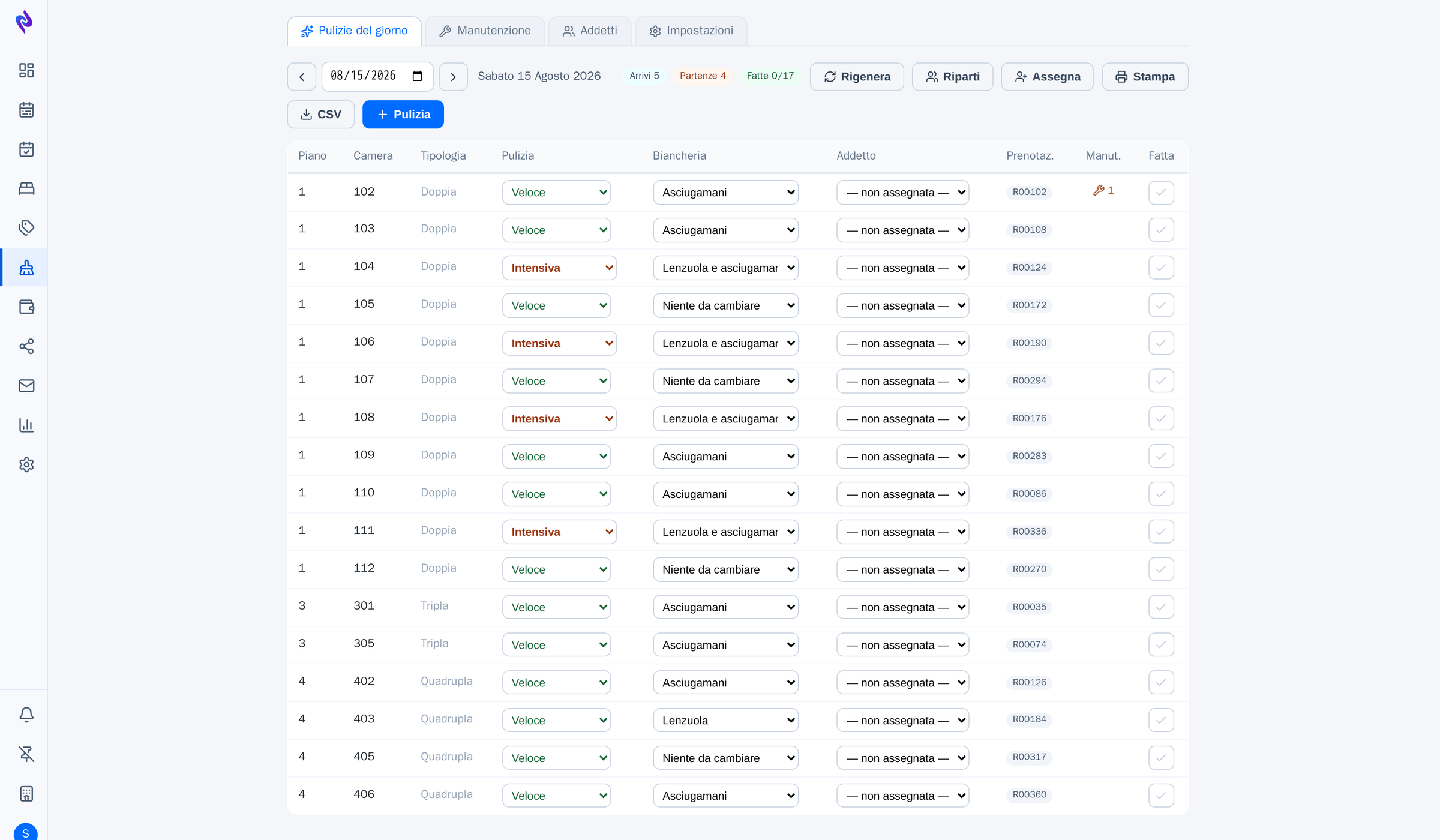
The day plan builds itself from arrivals, departures and stayovers, with a quick or a full clean and linen decided by rules you wrote once. The housekeeper opens it already done and corrects it if needed — which is the difference between writing and reviewing.
Whoever cleans works from a phone, on a dedicated address that needs no account: they mark the room ready and the front desk sees it without calling. A fault reported from the plan becomes a blocked room, and a blocked room is not resold — because the system keeps count, not the memory of whoever is on shift.
No, and that would be the main reason a tool like this never gets adopted. They work from a dedicated address opened on a phone: whoever cleans sees the day's list and marks what they have finished, with no password to remember and no training.
That address can be changed when the staff changes, which is the part that actually matters.
That is the normal case, not the exception. Which is why the rule is that the tool has to be usable without explanation: if it takes hand-holding to mark a room clean, by June nobody is using it.
It changes who looks at the list, not the list. The contractor sees the day's rooms with the type of service required; what they do not see is guest data, which they do not need.
It is also the case where a system-generated plan is worth most: with an external supplier, verbal instructions turn into disputes.
No, and the reason is the same one that makes the module useful: the plan is generated from booking data. Housekeeping is part of the PMS, not a product of its own — unlike revenue management and cost control, which are sold separately and connect to what you already run.
If your PMS suits you and housekeeping is the only sore point, the honest answer is that replacing everything for that is not worth it.
It is worth one check before closing the subject, though: housekeeping is rarely the only place time goes. The PMS check-up measures four more areas besides this one, and if the rest really is in order you will know in five minutes.
The two measurable items are preparing the plan (half an hour a day, every day) and the phone calls between the desk and the floors. We do not promise a percentage: it depends how many rooms you have and how orderly your process already is.
Half an hour, with your own arrivals and departures in front of us — not a generic demo.
Request a demo