What does a sold room cost?
Not the price: the cost. Cleaning, linen, breakfast, channel commission, a share of energy. Without that number a 15% discount can be a good deal or a loss, and you will not know until year end.

Management accounting
You know your revenue to the day. You know your margin in June, when the accountant closes the previous year — and by then it is a photograph, not a decision.
The problem
Statutory accounts exist to tell the tax authority how much you earned. They do not exist to tell you where: those are two different jobs, and asking the first to do the second is why so many hotels cannot answer three simple questions.
Not the price: the cost. Cleaning, linen, breakfast, channel commission, a share of energy. Without that number a 15% discount can be a good deal or a loss, and you will not know until year end.
Both answers are legitimate — a loss-making restaurant that fills the rooms can make sense. But it is a decision, and to make it you need to know rather than sense it.
Not the one with the highest ADR: the one with the highest ADR minus commission, minus acquisition cost, minus cancellations. The ranking changes, and sometimes it flips.
The method
USALI (Uniform System of Accounts for the Lodging Industry) is the scheme the hotel industry uses to split accounts by department — rooms, food and beverage, other — attributing to each its own revenue and its own direct costs.
It is not a regulation and nobody imposes it: it is a convention, and it does two things a statutory chart of accounts does not. First, it tells you which department earns. Second, it lets you compare yourself with other hotels, because they are counting the same way.
| Question | Statutory accounts | Your own spreadsheet | USALI management accounting |
|---|---|---|---|
| When the numbers arrive | In June, about last year | When you have time to update it | Every month, from the PMS data |
| Margin by department | no | If you built it yourself | yes |
| Cost of a sold room | no | Approximate | yes |
| Margin by sales channel | no | Rarely | yes |
| Comparable with other hotels | No: it depends on the chart of accounts | no | Yes, that is the point of a shared scheme |
| Who keeps it up to date | Your accountant | You | The system, from data you already enter |
The spreadsheet is not the wrong choice: it is the choice that works as long as you update it. The trouble is that it stops in exactly the months when it would matter most — the full ones.
Where we come in
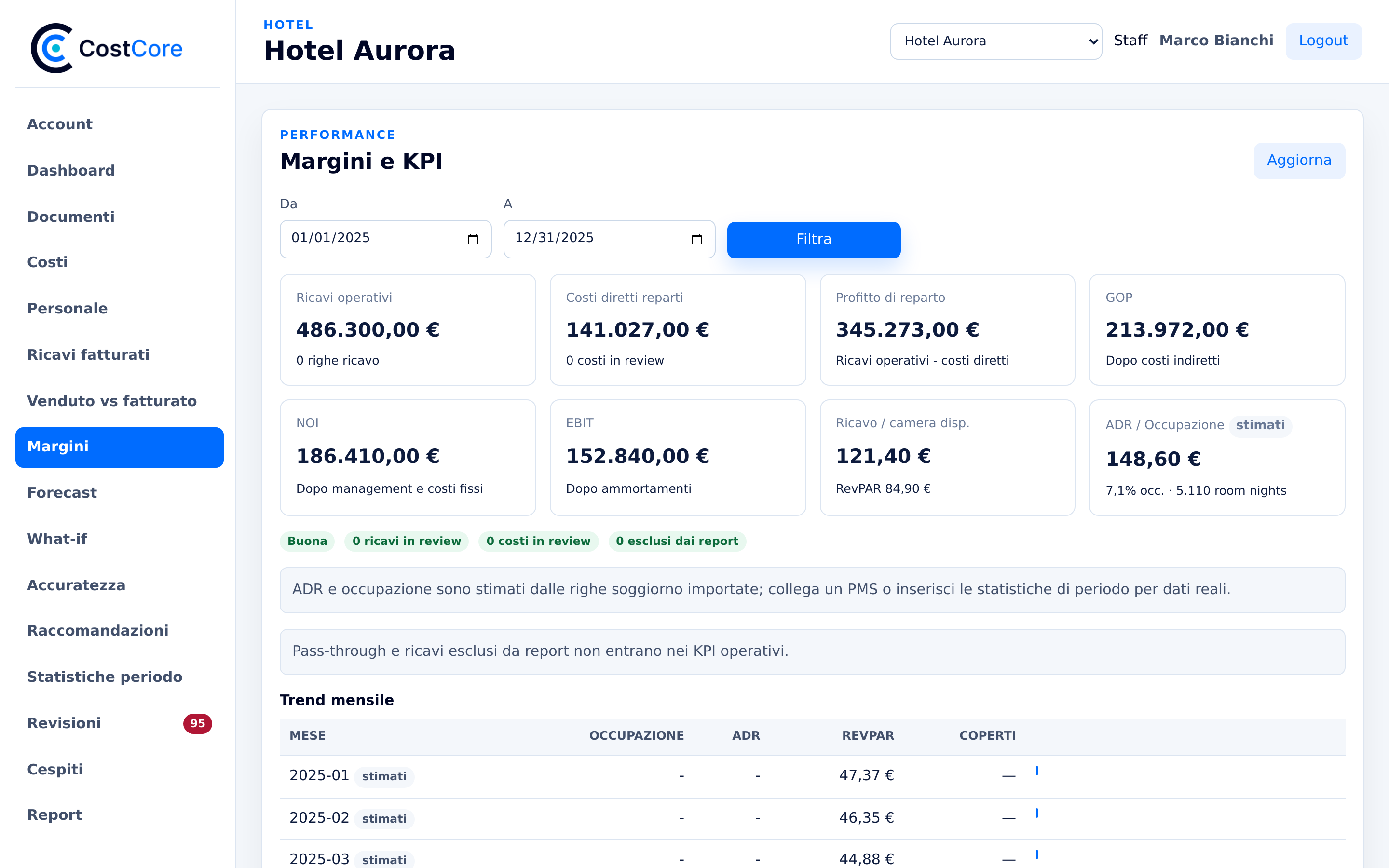
It takes revenue from the PMS and costs from where they arise — invoices, suppliers, payroll — and puts them into the departmental scheme. If the PMS is OS that revenue arrives on its own, night by night; if it is another one, or none at all, it is imported. The result is a P&L that keeps itself current, with margin by department and cost per sold room, plus a cost projection built on the same occupancy scenario as the revenue.
It connects to a PMS that is not ours too: replacing your PMS in order to do management accounting would be a project that serves nobody.
No, and it does not try to. Your accountant does the statutory accounts and the filings: those are compulsory and they answer to the tax authority. Management accounting answers to you, every month, about things that are not in the statutory accounts — which department earns, what a room costs, which channel pays.
The two run on the same data and do not overlap.
Yes, and only the number of departments changes. Even a rooms-only property has costs that behave differently: those that follow rooms sold (cleaning, linen, breakfast, commissions) and those that stay fixed whatever happens. Separating them is already half the work.
Revenue depends on which PMS you run: if it is ours it arrives on its own, night by night; if it is another one it is imported, which is a periodic step rather than a daily one. For costs it depends how you receive them: electronic invoices are read automatically, paper ones are recorded the way you already record them.
The part that asks for your time happens once, at the start: deciding which cost belongs to which department.
The first closed month already gives you margin by department. Real comparisons need twelve months, because seasonality moves everything: an October is not judged next to an August, it is judged next to the October before.
Not an example: your numbers, split by department, in half an hour.
Request a demo