
A PMS records, it does not manage: why the system of record is not the system of control
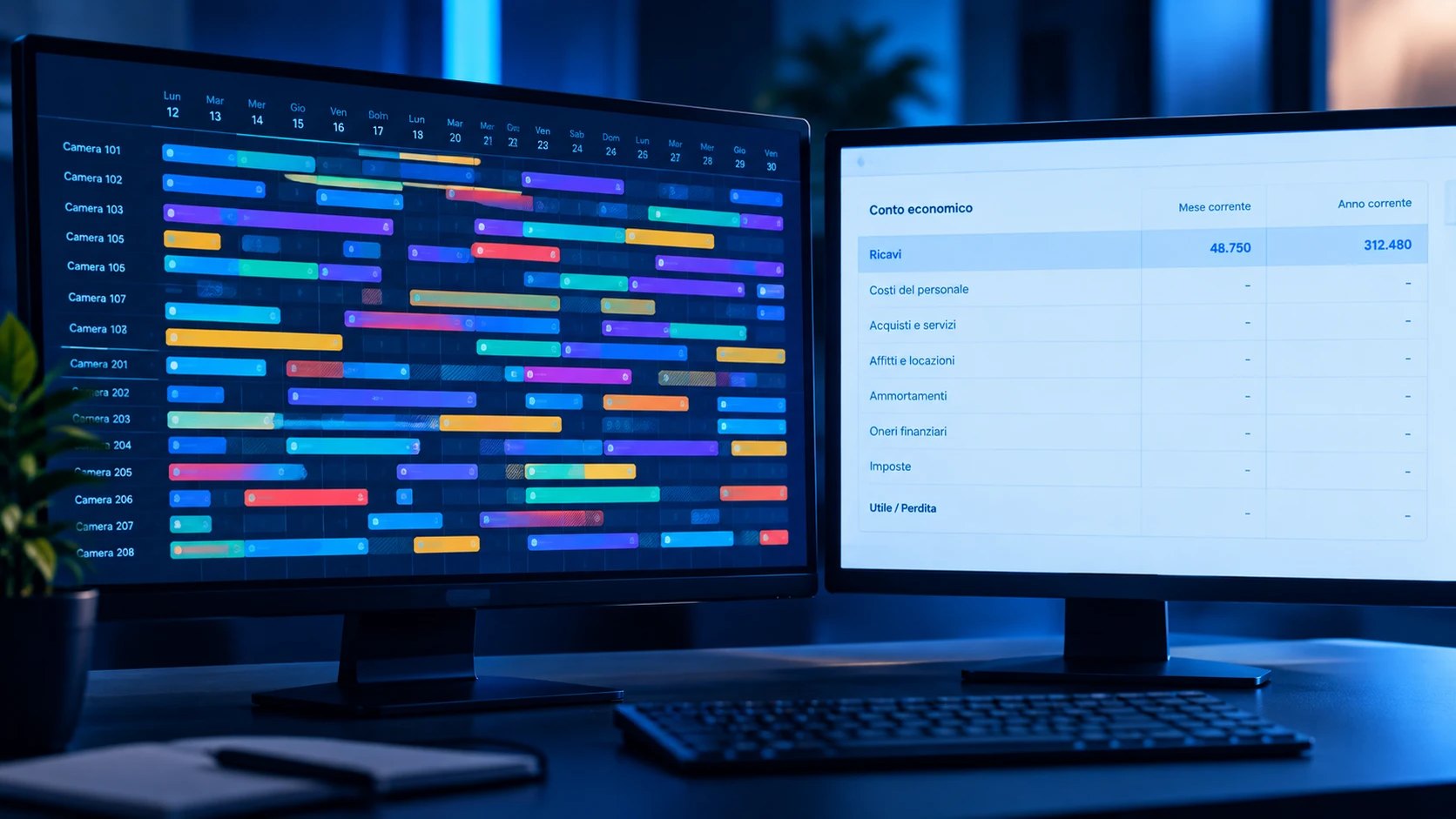
In almost every Italian hotel there is a piece of software everyone calls «the management system». It records bookings, assigns rooms, produces folios, files guest data with the police, issues invoices. In the operator’s mind it is the centre of the business, and it is also the technology line item defended longest. And yet, when that same hotelier is asked which department is eroding the margin, what the full cost of an occupied room is, or how operating profit has moved against the same quarter last year, that system does not answer. Not because it is badly built, but because it was never built to do that.
The word management system promises something the software, in almost every case, does not do: manage. It does something else, indispensable but different: record. Confusing the two functions is probably the most expensive misunderstanding in Italian hotel technology, because it leads people to judge an investment against the wrong criteria and to postpone, for years, building the thing that is actually missing.
Recording and controlling are two different trades
A property management system is born as a system of record. Its job is to keep track of discrete events: a booking arrives, a room is occupied, a service is charged, a folio is closed. It does this well, and the data it produces is reliable on the room revenue side because it is the same data that generates the invoice.
A system of control answers questions of the opposite nature. It does not ask what happened to a transaction, but what it cost to produce that revenue, where the margin was consumed, which department absorbed resources without giving them back. That requires information the PMS does not hold and was never asked to hold: labour cost by responsibility centre, departmental purchases, allocated utilities, depreciation, leases, distribution cost by channel net of the commissions actually paid.
The consequence is structural. The PMS knows RevPAR because it calculates it from its own data. It does not know GOPPAR, because gross operating profit comes from a chart of accounts that lives elsewhere — usually in the books kept by an external accountant, on a tax logic rather than a management one, arriving on a cycle that lands after the decisions have already been made. Between the system that knows everything about revenue and the system that knows something about cost there is almost never a bridge, and in the gap sits the spreadsheet the hotelier updates on Sunday night.
That this distance is felt is confirmed by the 2026 HotelTechReport survey on property management systems, where reporting and business intelligence appear among the priorities stated by 48% of operators: a polite way of saying that today the capability is not there.
A note on sources, valid for every figure quoted in these pages. The survey just cited draws on 450 professionals with at least eight years of experience, working in properties above fifty rooms, with a stated margin of error of ±4.9%. It is the most solid international sample available, but it describes a segment that is a minority in Italy: on Federalberghi’s analysis of ISTAT data the average Italian hotel has just over 33 rooms, and three-star properties together with aparthotels account for 55.2% of national supply. The numbers should therefore be read as indicators of direction, not as a measure of the Italian market. Much of the remaining literature is produced by software vendors and exists to steer a purchase: here it is used to map problems, never to quantify them.
Why the distance matters now
For many years the separation between recording and controlling was tolerable, because nobody penalised it. That is no longer the case, and the reason is not technological but regulatory and financial.
Article 2086 of the Italian civil code requires the entrepreneur to put in place organisational, administrative and accounting arrangements appropriate to the nature and size of the business, including for the purpose of detecting a crisis in good time. The Business Crisis Code turned that duty into a test of liability.1 On the credit side, the European guidelines on loan origination shifted bank assessment from assets to the prospective capacity to generate cash flow,2 which means a hotel that produces no reliable forward-looking figures is not merely less organised: it is less fundable.
In that context the question «does my PMS give me the numbers?» stops being a matter of operational convenience and becomes a matter of access to credit. A system that records transactions but feeds no management control leaves the business without the very instrument the bank now expects to see.
The Italian perimeter the international debate does not see
There is a second evaluation criterion that the anglophone literature ignores entirely, and that in Italy carries more than half the decision: the compliance load.
An Italian accommodation business must transmit every guest’s identity details to Alloggiati Web within twenty-four hours, report tourism flows to the regional statistical portal, calculate collect and remit the tourist tax under a municipal regulation that changes from town to town, issue electronic invoices through the Exchange System, and display the national identification code.3 The statistical portal, in particular, is not one portal: the regions have adopted around twenty, with different names and different formats for the same function. Penalties for failure to report are modest in absolute terms but cumulative, and they produce knock-on effects on tax audits and on eligibility for regional grants. Since 20 May 2026 the European short-term rental regulation has added a further layer of data transmission and cross-checking.4
This means that comparing an international cloud platform with an established Italian suite is not a like-for-like comparison, and assessing them on the same feature sheet is a methodological error. The first may be better on interface, technical openness and release speed; the second natively covers a perimeter of obligations which, if left uncovered, has to be rebuilt with additional integrations or with manual work by staff. The cost of that manual work rarely enters the comparison, and it is almost always the heaviest line.
What to actually ask before signing
If the basic features have levelled out — and in the front office they effectively have — then the choice moves onto dimensions that never appear in a sales demo.
The first is data ownership and portability. The reassurance that the data belongs to the hotel is not enough: ask in what format it comes out, with what historical depth, in what timeframe, at what cost, and whether the operation is contractually provided for or left to the vendor’s goodwill. A written exit clause is worth more than ten features.
The second is the real openness of the interfaces. The useful questions are whether the technical documentation is public, whether API access is included or charged for, whether there are recurring fees to keep each individual connection open, who takes on maintenance when either system updates, and whether the exchange is two-way or one-way and at what sync frequency. On that last point it pays to be pedantic, because a connection that updates on an interval rather than in real time is enough, in high season, to generate overbooking. Bear in mind that «open APIs» has become a sales argument and tends to overstate real portability: the stickiest data — folios, rate logic and payment credentials — stays proprietary enough to make switching costly anyway.
The third is total cost of ownership. The list price describes a fraction of the real spend, to which must be added separately activated modules, onboarding, training, migration and any connection fees. A quote that does not itemise these is not a quote.
The fourth is reliability, which in practice is the real breaking point. Again on the 2026 survey, 48% of operators would switch vendor over service continuity problems and 42% over information security: far higher than the shares attributed to missing features. So ask for written service levels, fallback procedures during maintenance windows, and compliance standards on personal data and on payments.
The fifth, which closes the circle this article opened with, is the ability to feed the control function. The question is not whether the system produces reports, because they all do, but whether its data can be exported in a structure that reconciles with a chart of accounts by responsibility centre. If the answer is no, that is not necessarily a defect: it means the function has to be built one level up, and has to be budgeted as a project in its own right rather than waited for, in vain, from the PMS vendor.
The anatomy of the fear
What remains to be explained is why, with criteria this identifiable, most hoteliers do not change system even when it is manifestly inadequate.
The stated barriers are two, and they are coherent: 26% of operators name staff training as the main obstacle to switching, 24% the complexity of data migration. Anyone who has been through a migration once knows that something gets lost, that staff slow down for weeks, and that the months immediately after are the most exposed to error. Hence the rational choice to stay on a system that half works.
What is interesting is that migration today is considerably less painful than it was ten years ago, while the perception of the risk has stayed fixed in that era. This gap between reality and perception produces an asymmetric effect: the cost of changing is estimated precisely and overstated, the cost of staying is not estimated at all. Yet the latter exists, and it is made of hours of manual work on duplicated compliance, of decisions taken without data, of automations that cannot be switched on because the system does not expose the necessary information. The right question is not what migrating costs, but what another three years of standing still costs.
Artificial intelligence and integration debt
The last topic needs handling with care, because it is the ground with the highest density of marketing and the lowest quantity of verifiable results.
The solid core is this: older platforms expose limited interfaces and inconsistent data schemas, and connecting artificial intelligence tools to them produces duplicate guest records, broken flows and what the industry has begun to call integration debt — the condition in which every new tool is harder to connect than the last. The practical implication is that automation is not bought downstream, it is enabled upstream. A hotel that cannot reconstruct a coherent guest profile across booking, stay, payment and communication is not ready for artificial intelligence, whatever tools it buys.
Above that layer a recurring architectural direction is consolidating: a governed data layer sitting above the PMS and holding the trusted version of information on guests, rates and suppliers, and a standard interaction protocol between conversational assistants and business systems, adopted to avoid every agent requiring a dedicated connector to every system. On the distribution side, this infrastructure is what makes it technically possible for a property’s real availability and rates to be read and booked inside a conversational interface, without the user ever opening a website.
It should be said plainly that at present this is mostly announcements, pilots and early enterprise connections, not established practice: for an independent Italian property it is not a decision for the coming quarter. It is, however, one more reason to ask the interface-openness question now, at selection time, because that is what will determine, in two or three years, whether the property can take part in that channel or will reach it — once again, through intermediaries.
Conclusions
The PMS remains the most important system in a hotel, but for reasons different from the ones usually attributed to it. It is not important because it runs the business, which it does not: it is important because it is the point where the data is born, and the quality with which it produces and exposes that data determines everything that can be built downstream, from management control to automation.
From this follows a different way of assessing it. Front office features, which take up most of the demo, are now the least discriminating criterion. What counts is interface openness, real data portability, native coverage of Italian compliance, service continuity, and the ability to reconcile the data with a control structure. And what counts most is recognising that management control will never arrive from the PMS: it has to be designed as a function in its own right, fed by the PMS but not the same thing as it.
The hotelier who asks their system only to do well the thing it was born to do, and builds elsewhere what is needed in order to decide, will end up in a better position than the one who keeps waiting for a single piece of software to solve two problems that are not the same problem.
Frequently asked questions
What is the difference between a PMS and a management control system? A PMS is a system of record: it tracks bookings, occupancy, charges and folios, and produces reliable data on room revenue. A management control system processes costs, margins and results by responsibility centre, and requires a management chart of accounts that the PMS normally does not hold. The two work on different data and answer different questions.
Why does a PMS not calculate GOPPAR? Because gross operating profit derives from departmental operating costs — labour, purchases, utilities and services — which live in the accounts and not in the PMS. The PMS calculates RevPAR because it draws it from its own data; GOPPAR would require a stable integration between revenue data and cost data reclassified on a management schema.
Which criteria actually matter when choosing a PMS in 2026? Data portability and exit clauses, openness and cost of integration interfaces, native coverage of Italian compliance, service continuity and security, total cost of ownership including modules and connection fees, and the ability to export data that reconciles with a chart of accounts.
Why are an international PMS and an Italian one not comparable on the same features? Because Italian properties have to discharge specific obligations — guest reporting to the public security authorities, tourism flow reporting to regional statistical portals that differ from one another, municipal tourist tax, electronic invoicing, national identification code — which some platforms cover natively and others do not. Where the coverage is missing, the load shifts onto staff or onto additional software, and that cost belongs in the comparison.
What does changing PMS really cost? The two main barriers operators name are staff training and the complexity of data migration. To those add onboarding, running both systems during the transition, and reduced initial productivity. The correct comparison, though, is not between the cost of changing and zero, but between the cost of changing and the cost of staying — the latter made of recurring manual work, decisions taken without data, and automations that cannot be switched on.
Do you need a modern PMS to adopt artificial intelligence in a hotel? What you mainly need is a coherent, accessible data foundation. Artificial intelligence tools applied to systems with limited interfaces and duplicate guest records produce errors and generate integration debt, progressively making every subsequent connection harder. Interface openness is therefore a precondition for automation, not a consequence of it.
Notes
Footnotes
-
Article 2086, paragraph 2, of the Italian civil code, introduced by article 375 of Legislative Decree 14 of 12 January 2019 (Business Crisis and Insolvency Code). The duty to establish adequate arrangements applies to entrepreneurs operating in corporate or collective form; sole traders are required to adopt measures suitable for detecting a state of crisis in good time. ↩
-
Guidelines on loan origination and monitoring, EBA/GL/2020/06, European Banking Authority, 29 May 2020, applicable to new lending from 30 June 2021. ↩
-
In order: article 109 of the Italian Consolidated Public Security Act (Royal Decree 773 of 18 June 1931) for reporting guest identity details, within twenty-four hours of arrival and within six hours for stays shorter than that; the electronic invoicing obligation through the Exchange System; the national identification code introduced by article 13-ter of Decree-Law 145 of 18 October 2023, converted with amendments by Law 191 of 15 December 2023, mandatory from 1 January 2025. The tourist tax is governed by municipal regulation, and therefore varies in rate, exemptions, frequency and payment method from one municipality to the next. ↩
-
Regulation (EU) 2024/1028 of 11 April 2024 on data collection and sharing relating to short-term rental accommodation services, applicable from 20 May 2026. ↩