
Hotel access control: a comparative guide to choosing
For a long time, how a guest opened their bedroom door was regarded as a detail of the building’s fabric, filed away among maintenance decisions. That reading no longer holds. The access control system touches on some of a property’s most delicate balances: the security of guests and their belongings, the quality of the first impression on arrival, the daily labour cost at reception and, increasingly, responsibility for the processing of personal data. The credential that opens the door has become, in other words, a choice that says as much about a hotel’s positioning as its furnishings or its service.
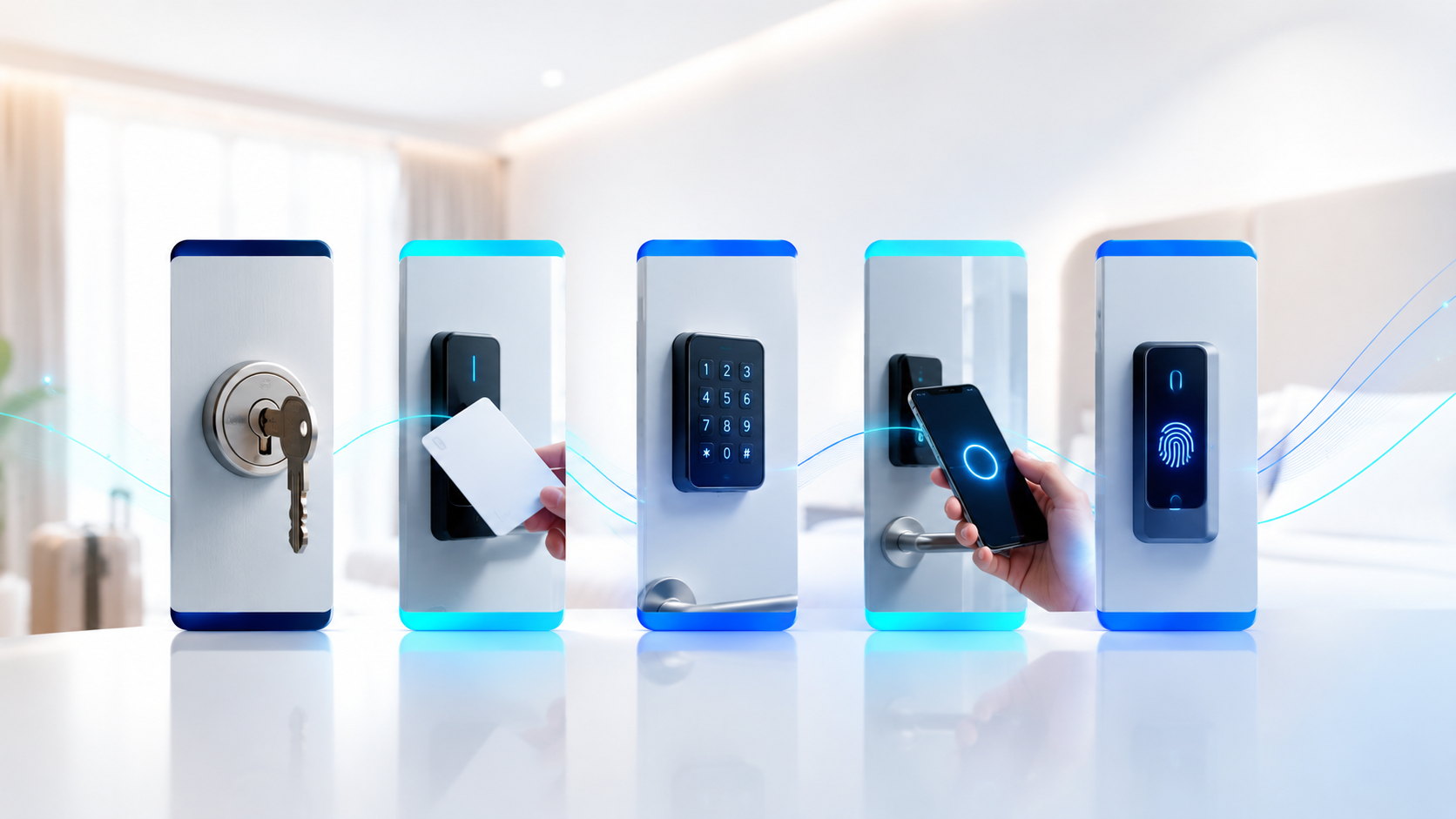
The available technologies sit along a line running from the old metal key to biometric recognition, by way of cards, numeric codes and digital keys on a smartphone. None is better than the others in absolute terms: each expresses a different trade-off between simplicity, security, guest experience and cost. This article compares them against consistent criteria, with the aim of giving whoever has to decide a compass suited to their own situation.
The mechanical key: simple and durable, but blind
The traditional lock with a physical key remains the reference point in any discussion of the subject. Its merit is robustness: it works without electricity, fears neither electronic failure nor power cuts, and depends on no network. Where the technology infrastructure is fragile or hard to justify on cost grounds, the key retains a stubborn rationality of its own.
Its limitations, though, are substantive. A mechanical key leaves no record of who entered and when, and it cannot be cancelled remotely: if a guest loses one, the only genuinely safe response is to change the lock, with the expense that entails. It is easily and untraceably copied. This is why the physical key survives today mainly in very small properties, in the lowest-budget solutions and — an aspect often overlooked — as the emergency key retained even in the most technologically advanced hotels, the last resort when the electronics stop working.
The keycard: the widespread standard and its weak point
The keycard has replaced the metal key in most medium and large hotels, becoming the standard almost every guest recognises. Two very different technologies coexist within it, however. The magnetic stripe card is the cheapest, but also the most delicate: it demagnetises on contact with other devices, wears out with use and, above all, is easy to copy because the data it holds is not protected. More recent cards, which are presented to the reader without needing to be swiped, work more reliably, are conveniently reprogrammed, and integrate with the hotel’s PMS, which ties the permission to the booking and expires it on departure.
Yet it is precisely around keycards that the most instructive security incidents of recent years have clustered. In 2012 a researcher showed that a lock model extremely common in hotels could be opened in a fraction of a second using hardware costing a few tens of dollars; the discovery, once made public, was subsequently exploited in a series of real burglaries. More recently, in 2024, a group of researchers demonstrated that one of the most widely installed families of electronic locks in the world — present on some millions of doors in over one hundred and thirty countries — could be opened with a forged card, derived from a single card from the same hotel, even an expired one retrieved from the bin of used cards. The most significant point for an operator, though, is not the ingenuity of the attack but its tail: a year after the discovery, a good proportion of the affected locks were still not updated, because fixing the problem required physically visiting every door.
The lesson is managerial rather than technical. A card is as secure as the protection of the data it holds and as prompt as the manufacturer is in releasing updates: choosing the supplier, and the discipline of keeping the installation up to date, matter at least as much as the initial technology. To this can be added a not insignificant environmental issue, if you consider the hundreds of tonnes of plastic cards the sector sends for disposal every year.
The keypad with a per-booking code: the most efficient answer for many properties
The numeric keypad deserves particular attention, because it pushes the logic of automation furthest: it eliminates the object to be handed over entirely and turns the key into pure information. Each booking is assigned a different code, which is generated and revoked remotely and which logs entries. An entire chain of activities and costs that the other physical solutions carry with them simply falls away: there is nothing to produce, encode, hand over, collect back or remake when lost, and there is no consumable to reorder. The marginal cost per guest tends, in substance, towards zero.
This is precisely where its operational efficiency lies. The code can be generated automatically by the PMS at the moment of confirmation and delivered in advance by email or message, valid only for the dates of the stay. The guest arrives already knowing their code and enters without going via reception: the keypad therefore enables, better than any other solution, an operation with reduced or unstaffed reception, ideal for non-hotel properties and for anyone who has built their model on self check-in. The same logic extends to staff: housekeeping and maintenance can be given their own codes, with an access log that increases control without multiplying the keys in circulation.
Alongside this administrative lightness comes an often underestimated advantage in robustness. Many code lock models also work offline, verifying the code’s validity locally without depending on a continuous connection: no small merit compared with smartphone keys, which require connected locks and reliable network coverage along the corridors. On cost, the keypad also avoids the investment in infrastructure and applications that the more advanced digital solutions entail, sitting at a contained initial outlay. In many properties, in short, it is the technology that delivers the best ratio of autonomy, control and cost.
Its drawbacks are real, but should be read for what they are: manageable aspects rather than obstacles. Over time the most-used keys tend to wear, suggesting to a sharp eye which digits make up the codes; the problem is mitigated by scrambled keypads, which shuffle the positions of the numbers, or by longer codes. A code, moreover, is easily shared and can be observed as it is typed, and there will always be the guest who forgets it, with the consequent return to reception — an inconvenience quickly resolved by simply resending the code. Finally, it should be noted that while the keypad is the most efficient solution for lean operations, it remains less common as the primary room key in upper-tier hotels: not for any failing in how it works, but as a choice about experience and perception, where the act of typing a code communicates less care than other methods. Its natural home therefore remains non-hotel properties, short lets, small lean operations and access to common areas — contexts in which its efficiency expresses itself without compromise.
The digital key: the app and the phone wallet
The current frontier is the digital key, which turns the guest’s smartphone into the room key. It does so in two ways. The first goes through an app — the brand’s or the hotel’s — which opens the door when the phone is held to the lock. The second, simpler and likely to prevail, puts the key directly into the phone’s digital wallet, alongside payment cards and boarding passes, without the guest having to download anything: you use it as you would a public transport card. Some chains have already extended this across their entire portfolio, while several large groups offer it on selected properties.
On security, the digital key offers tangible advantages: it is valid only for the dates of the stay, it is tied to the individual phone, and it can be neither duplicated nor forwarded. Guest adoption, where the service is mature, is estimated at between a quarter and two fifths of customers, with a clear preference among younger travellers and frequent business travellers. Two conditions should not be underestimated, however. The first concerns installation: digital keys require compatible locks, which means choosing between upgrading the existing locks and replacing them, as well as reliable network coverage along the corridors. The second concerns inclusivity: not every guest has a compatible phone or wants to manage access from a smartphone — think of international guests, those less confident with technology, or group bookings where the key would need to be shared among several people. Keeping a physical alternative is therefore not an affectation but an operational necessity.
Biometrics: the frontier and its cautions
At the most advanced extreme sits biometric recognition, which is in fact already present indirectly: keys held in a phone are normally protected by the face or fingerprint with which the guest unlocks the device. Direct use of biometrics on the bedroom door — a sensor recognising a face or a fingerprint — remains limited, and is more common on high-security access points than on guest rooms. Its advantage is obvious: the key coincides with the person and cannot be lent, lost or copied.
That very coincidence, however, moves the decision onto a plane that is no longer merely technological. For a European property, biometric data is a specially protected category of personal data, whose processing requires a solid legal basis, a risk assessment and, as a rule, the guarantee of an alternative for anyone unwilling to provide it. It follows that, in the European regulatory context, biometrics as the routine room key remains a niche choice, to be weighed with particular caution and assessed on compliance grounds as much as on technical ones.
Comparison at a glance
The table below summarises how the different solutions sit against the main selection criteria. The judgements are indicative and assume a correct installation kept up to date.
| Criterion | Mechanical key | Keycard | Code keypad | Digital key | Biometrics |
|---|---|---|---|---|---|
| Security | Low | Low to medium | Medium | Medium to high | High |
| Initial investment | Very low | Low–medium | Low | High | Very high |
| Running costs | Medium | Medium | Low | Low | Medium |
| Guest experience | Traditional | Familiar | Decent | Seamless | Seamless but delicate |
| Resilience to failure | Very high | Medium | Medium | Low to medium | Low |
| Audit trail and revocation | None | Good | Good | Excellent | Excellent |
| Sustainability | High | Low | High | High | High |
| Privacy burden | None | Low | Low | Medium | High |
How to choose, by type of property
No single solution emerges from the comparison as right for everyone, but rather a set of pairings consistent with the hotel’s profile. The decisive variable is not so much the star rating as the operating model the property has chosen for itself: how many staff cover the entrance, at what hours, and with how much autonomy left to the guest. It is along this axis that the different technologies find their natural place.
In non-hotel properties, short lets and small lean-run B&Bs, the code keypad is today the most coherent answer — not as a fallback but by design. These are settings where there is often no reception in the traditional sense, where the owner does not live on site, and where arrivals are irregular and at any hour: precisely the conditions in which automatic code generation, sending it in advance and expiring it at the end of the stay remove the one real bottleneck, namely the physical presence of someone to hand over a key. Add to that the offline operation of many models, valuable where connectivity is uncertain, and the ability to assign distinct codes to cleaning staff with an entry log. In these properties the keypad is not a cheap version of something else: it is the technology that best embodies their model, and it is where its efficiency expresses itself without compromise.
The same logic extends, with a little more caution, to small independent hotels and alberghi diffusi operating with reduced-hours or overnight-unstaffed reception. Here too the code elegantly solves the problem of out-of-hours arrivals and lightens the workload of a small team; the limit arrives when the clientele is very mixed or international, or when the volume of rooms makes a channel the guest perceives as more considered preferable. In these cases the keypad often remains the right choice for the room, but it should be accompanied by a physical alternative and clear instructions, and it is worth pairing it with common-area access. In larger budget hotels, where cost outweighs everything else, an up-to-date latest-generation keycard remains a solid basis, with the numeric code readily used on service doors and shared spaces.
Midscale and upper-tier hotels, and chains generally, benefit instead from a dual-track solution, pairing the keycard with the digital key and making the most of integration with the PMS and the brand app; here the keypad tends to retreat to secondary doors, where its practicality remains an asset without affecting the room experience. In the luxury segment, finally, the digital key enables a frictionless experience that must nonetheless be balanced against attention to human contact and discretion: this is the context in which the numeric code is least suited as the primary key, because the act of typing it communicates less care than the ritual of being welcomed. Across all of them, three precautions apply to everyone: always retain an emergency opening method, plan lock updates well in advance, and guarantee an alternative for guests who cannot or will not use the digital option. Ultimately, the more the operating model rests on automation and guest autonomy, the more the keypad proves the efficient choice; the more it rests on staffed service and relationship, the further the centre of gravity shifts towards keycards and digital keys.
Conclusions
The choice of access control system admits no single answer, because it consists in balancing — against the property’s positioning and its type of clientele — requirements that pull against one another: security, cost, guest experience, resilience when things go wrong and, increasingly, compliance. The point of equilibrium, as we have seen, depends less on the hotel’s category and more on its operating model: it is the extent to which a property has chosen to automate arrivals and entrust autonomy to the guest that determines which credential is genuinely coherent. Along this axis, efficiency and experience tend to pull in opposite directions, and recognising where your own property sits is the first step towards choosing the technology rather than submitting to it.
This is where the code keypad deserves consideration in its own right. Where the model rests on automation and lean management, the code is not a second-tier solution but the fullest expression of that model: it eliminates key logistics, is generated and revoked remotely, does not fear the absence of a network and produces no consumables, giving lighter operations the best ratio of autonomy, control and cost available today. That same code, in a hotel built on relationship and staffed service, would be perceived as cold: not because it works less well, but because it speaks a different language from that property. The best technology, in other words, is the one that says the same thing the hotel wants to communicate. The direction of the sector remains clear and points towards digital keys, but the transition will be gradual and layered: the different solutions will coexist for a long time yet, and physical backup alternatives will not disappear any time soon.
Two reflections close the argument. The first is that the security of a key is not a quality bought once and for all, but a condition to be maintained over time, through the choice of supplier and the consistency of updates: the incidents recalled above show that the risk almost always arises not from the technology itself, but from neglected maintenance. The second is that the closer the key comes to the identity of the person, to the point of coinciding with it, the more the technological decision becomes a data protection decision as well, with the responsibilities that follow. It is in holding these two insights together — security as continuous stewardship, and the growing proximity between credential and identity — that an accommodation business can turn an apparently technical choice into a coherent element of its own value proposition.
Frequently asked questions
What are the main access control systems for hotels? There are essentially five solutions available today: the traditional mechanical key; the keycard, either magnetic stripe or latest-generation contactless; the numeric keypad with a code tied to the booking; the digital key held in a smartphone app or wallet; and, at the most advanced extreme, biometric recognition. Each expresses a different balance between security, cost and guest experience.
Are hotel electronic locks secure? They are, provided you choose them from reliable suppliers and keep them updated over time. The best-known incidents of recent years have shown that the risk almost always arises not from the technology itself, but from neglected maintenance and the slowness with which updates are applied to locks already installed.
Which properties is the code keypad best suited to? The keypad shows its efficiency above all in non-hotel properties, short lets and small lean-run hotels, where it enables independent arrival and self check-in without a staffed reception. It is less suited as the primary room key in upper-tier hotels, for reasons of experience and perception rather than of function.
Is the smartphone digital key worth adopting? The digital key offers concrete advantages in security and experience, since it is valid only for the dates of the stay and is tied to the individual device. It does, however, require compatible locks and a reliable network, and it makes it essential to keep an alternative available for guests who cannot or will not use a smartphone.
Can biometrics be used as a room key in Europe? Its direct use on the bedroom door remains limited. For a European property, biometric data is a specially protected category of personal data, whose processing requires a solid legal basis, a risk assessment and, as a rule, the guarantee of an alternative for anyone unwilling to provide it.