
What can actually be automated in a hotel
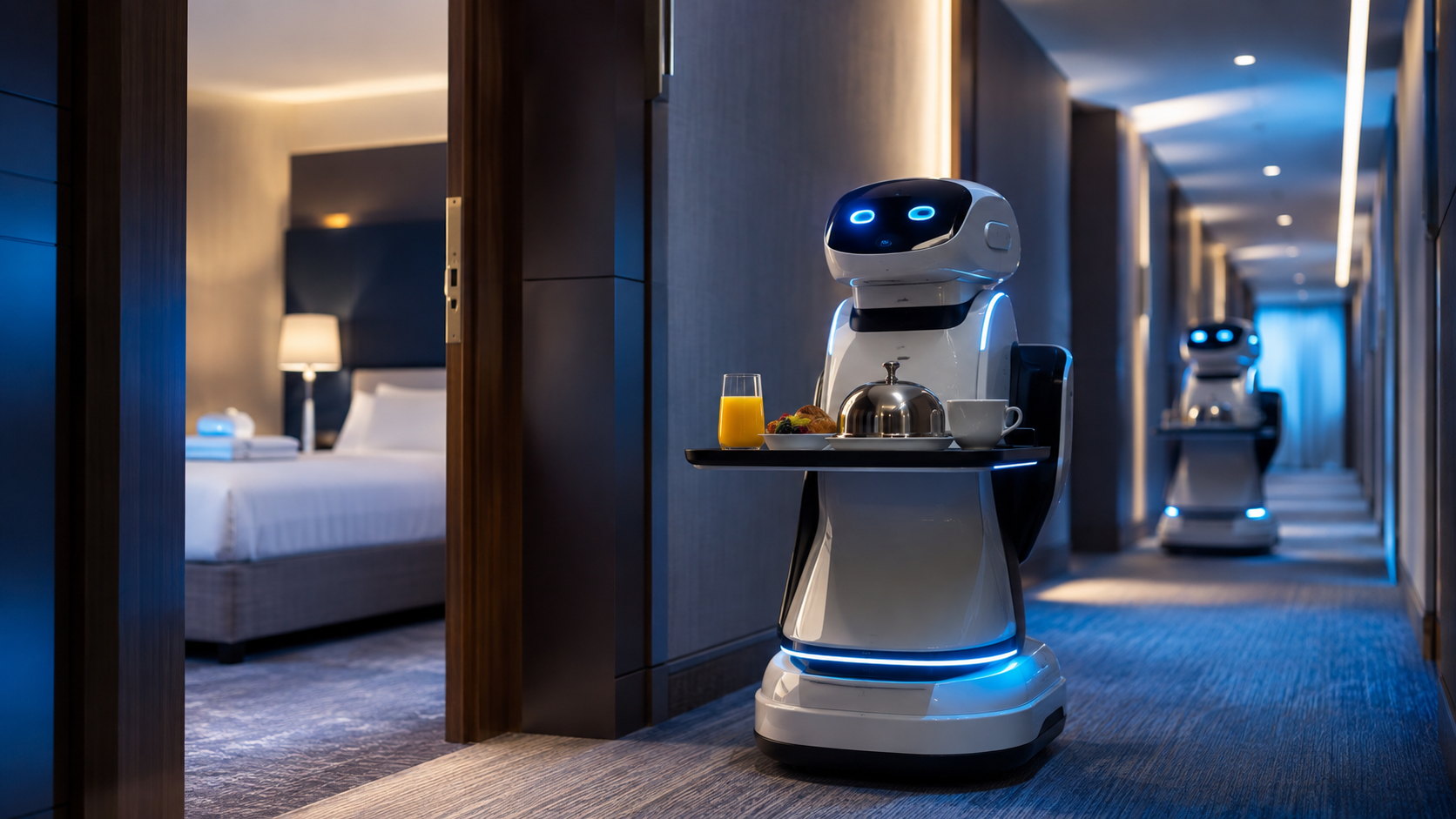
The question is almost always asked badly. “What can be automated in a hotel” is a question supplier catalogues are happy to answer, and the answer is always the same: everything. Check-in kiosks, digital keys, delivery robots, voice assistants, chatbots, automated pricing systems, housekeeping software, accounting automation. The list grows every year, and each entry arrives with a saving attached.
The useful question is a different one: which automations, tested on real properties over long periods, have actually reduced work rather than moving it somewhere else? That question can be answered, because the last ten years have produced enough documented cases — including several failures described openly by the people involved — to tell a criterion apart from a fashion.
This article is about hotels, not short-let or self-catering accommodation. The distinction is not a formality: a remotely managed apartment and a seventy-room three-star hotel face different operational, legal and organisational constraints, and the solutions that work for the first rarely transfer to the second.
The case that defined the debate, and that almost everyone cites badly
In 2015 the Japanese group H.I.S. opened the Henn na Hotel in Nagasaki, inside the Huis Ten Bosch theme park: the property entered the Guinness Book of Records as the first hotel in the world staffed by robots. Guests were greeted at reception by a humanoid or by an animatronic dinosaur in a porter’s cap, luggage travelled on autonomous trolleys, and every room had a voice assistant called Churi.
In 2019 the Wall Street Journal reported that the hotel had “fired” more than half of its 243 robots. The story went round the world in its simplified form — robots don’t work, hospitality is human — which is also the least useful reading of it.
The actual reasons are more instructive. Churi interpreted guests’ snoring as a voice command and woke them repeatedly during the night asking them to repeat themselves. The reception robot could not answer elementary questions such as flight times or the opening hours of the adjacent park, and for that task it was replaced by a person. But the decisive point was the one the staff brought out: employees were working overtime repairing robots that had seized up, and one staff member interviewed after the decommissioning said the job had become easier now that guests no longer called them to solve problems the machines had caused.
The Henn na Hotel did not demonstrate that robots don’t work. It demonstrated that an automation that does not handle its own exceptions does not reduce work: it turns it into maintenance work, and shifts it onto staff who were not hired to do it. The lesson holds identically for a badly configured chatbot, or for housekeeping software nobody keeps up to date.
There is a second element, less visible and more expensive. As the academic Stanislav Ivanov observed on the case, the robots required regular maintenance and continuous software updates, and none of that was cheap. The purchase cost of a service robot today sits, according to the most widely cited market surveys, between twenty and one hundred thousand dollars per unit (roughly €17,000-86,000), with rental formulas around thirty to fifty dollars a day (roughly €26-43). None of those figures includes the cost of the time somebody on the property will have to spend keeping them running.
The opposite case: when automation is a design decision
If Henn na is the example of automation added to a traditional hotel, citizenM is the example of a hotel designed around automation. The difference produces opposite results, and it is worth understanding why.
The first citizenM check-in kiosk dates from 2007 — so the technology is almost twenty years old, which on its own should cool some of the enthusiasm about novelty. Check-in takes about a minute, check-out around thirty seconds, and there is no front desk: in its place is a lobby-living room with staff the group calls “ambassadors”.
The interesting operational detail is not the kiosk. It is that citizenM staff are trained across every function of the property and rotate between shifts: the same person who welcomes guests at the entrance may serve at the bar and, at night, handle the accounting close. Automation did not eliminate a job, it made a different one possible — more versatile, more expensive to train, but deployable where it is needed at the moment it is needed.
The figure that circulates everywhere about this model — 0.2 full-time equivalents per room against an industry standard of around 0.5 — should be treated with caution: it comes from a case study published by one of the group’s technology suppliers, not from an independent survey. It remains a strong signal, though, that after Marriott acquired the brand for 355 million dollars (roughly €305 million) the lean operating model was kept, rather than normalised towards the chain standard.
The closest Italian reference is B&B Hotels, which operates an “automated receptionist” able to guide the guest through document registration, issue a room number and access code, and sell a room on the spot to someone arriving after eleven at night without a booking. It is a hotel chain, not a short-let operator, and that makes it the most useful Italian case to study.
For completeness, it should be said that automating arrivals in Italy meets a limit that is not technological but legal: Council of State judgment no. 9101/2025 confirmed the obligation to identify guests de visu under Article 109 of the TULPS, and regional classification tables tie required staffed hours to the star rating awarded. We covered the question in detail in Self check-in and automated arrivals: what Italian law allows, and anyone weighing an investment in this direction should start there rather than with the quotes.
China, where hotel automation exists on an industrial scale
The European debate on these matters rests on a handful of cases, almost all of them recounted one at a time. In China, hotel automation is instead a mature industry, with a quantifiable market, a first wave that has already failed and a second one under way. It is worth looking at — not because the model transfers (it does not, for regulatory and cultural reasons we will come to) but because several questions that are still speculative in Italy have already received an empirical answer there.
The most photographed case is the FlyZoo Hotel in Hangzhou, opened between the end of 2018 and the start of 2019 by Fliggy, Alibaba’s travel platform, a short distance from the group’s headquarters. Two hundred and ninety rooms, no reception desk, facial recognition for access to lifts and rooms, a Tmall Genie voice assistant in each room, delivery robots and a robotic arm at the bar. Guest data is transmitted to the national public security system through a machine placed in the lobby.
Two details rarely surface in the enthusiastic accounts. The first is that FlyZoo has, since opening, continued to employ human housekeeping staff: the most expensive and most repetitive part of hotel work stayed outside automation even in the property built to prove that automation works. The second is that foreign guests, who cannot be registered by facial recognition as Chinese citizens are, are received by a member of staff who photographs their passport and face with a mobile device. Public reviews also record stays in which room delivery was made by a person because the robots were busy. The most quoted efficiency figure — a property one and a half times more efficient than its competitors — comes from a statement by the hotel’s chief executive, not from an independent measurement.
More interesting than the showcase is what is happening in the mass market. Yunji Technology, the leading Chinese supplier of hotel robots, listed on the Hong Kong stock exchange in October 2025, declaring partnerships with more than thirty-four thousand hotels across the Huazhu, Jinjiang, Home Inns, New Century and InterContinental groups, and a share just under fourteen per cent of its domestic market. Numbers that do not remotely exist in Europe. But the same filings tell the other half of the story: accumulated losses of eight hundred million yuan (roughly €95 million) between 2022 and 2024, and an average hotel robot price that fell — according to industry operators quoted in the Chinese technology press — from around one hundred and thirty thousand yuan (roughly €15,500) to around ten thousand (roughly €1,200), a drop of more than ninety per cent.
That figure deserves to be read properly, because it has a direct consequence for an Italian hotelier looking at a quote today. A service robot is cheap not because the technology is mature, but because the supply side is in a price war and losing money. It is a real opportunity on purchase price and an equally real risk on support, spare parts and the survival of the supplier over the medium term. The operational rule of thumb circulating among Chinese operators, reported by a Home Inns franchisee, is around one robot per fifty rooms: useful as an order of magnitude for judging whether such an investment makes sense in your own property.
The most instructive chapter, though, concerns staffless hotels. China had a first wave of fully automated hotels that has run its course, and the account given by the Chinese trade press at the start of 2026 lists causes that, at this point in the article, will sound familiar: security risks, damage, disputes with guests, complaints and plant maintenance brought costs and risks back to a level at which human intervention became unavoidable again. And alongside those, an obstacle of a different nature: regulation required automated check-in to be accompanied by a manual identity check, so “staffless” hotels could only ever exist in partial form.
It is exactly the constraint that in Italy follows from Article 109 of the TULPS. Two profoundly different legal systems reached the same conclusion for the same reason: the state wants to know who is sleeping where, and does not delegate that check to a machine. Anyone designing automated arrivals should treat this as a constant, not as local resistance destined to give way.
The second wave is under way regardless, with groups such as Jin Jiang, H World and Dossen entering it. A recent example, the Alilys Future Hotel in Longgang, Shenzhen, illustrates the problem that remains open: check-in completes in three steps between facial recognition, identity verification and automated key collection, as smoothly as a vending machine — but the building houses offices by day and karaoke bars and mahjong rooms by night, and there is no access control on the lifts at all: anyone who walks into the building can reach the guest floors. The arrival process is impeccable; the security perimeter does not exist. Automating a guest’s entry is not the same as automating control over who is inside the hotel, and it is a distinction that never appears in a quote.
The next experiment has already been announced: in June 2026 Pudu Robotics presented a forty-four-room hotel on the western artificial island of the Shenzhen-Zhongshan link, where robots are meant to cover reception, luggage, catering, cleaning and surveillance, with public trials at the end of 2026 and opening in 2027. Forty-four rooms is not many, and that is perhaps the most significant detail: after ten years of announcements, the full test is still being run on a small property.
What has not worked, and the thread that runs through the failures
The in-room voice assistant is probably the clearest case. Best Western trialled Amazon Echo devices in rooms to collect guest requests — an extra towel, a blown bulb — and its then chief executive David Kong described the outcome publicly at the Americas Lodging Investment Summit: most guests unplugged the device as soon as they entered the room, presumably so as not to be listened to, no improvement was recorded in satisfaction scores, and usage remained minimal.
Facial recognition at check-in followed a similar trajectory in Western chains: presented as the future of arrivals, it was scaled back in the face of privacy concerns and widespread guest discomfort. The comparison with China, where the same technology is an operational standard, shows that the decisive variable here is not technical maturity but the legal and cultural context the technology lands in — which makes it a poor idea to import conclusions about acceptability from Chinese cases.
The thread running through these cases is not technological. In all three — Churi, Echo, facial recognition — automation entered a space the guest considers their own: the room, the face, the conversation. The academic research converges fairly clearly on this point. A meta-analysis published in 2025 covering fifty-six studies on the acceptance of service robots in hotels identifies perceived usefulness and general attitude towards technology as the strongest predictors of acceptance, while noting how inconsistent the findings in the literature are with one another. In other words: guests accept automation when it solves a problem for them, not when it impresses them, and nobody yet has a reliable model for predicting where that boundary runs.
What works, and with what real numbers
On arrivals the staff saving is real and measurable, which makes the question less contentious than it is usually made to seem. What has to be understood is where it is generated, because it is not generated where almost everyone looks for it.
The basic arithmetic is simple and rarely done. A desk check-in occupies an operator for three to five minutes between greeting, document, registration, payment and handing over the key; the same operations at a kiosk or in an app close in about a minute and occupy nobody. In a property with forty arrivals a day that means almost a thousand hours of work a year concentrated in the moment of arrival alone: thirty per cent adoption frees up around three hundred of them, fifty per cent a little under a third of a full-time employee.
Industry benchmarks on digital keys indicate adoption of between twenty and thirty per cent of eligible guests in the first year, between twenty-five and forty in mature programmes, with peaks above fifty where the app is the default channel and staff actively promote it. These percentages are usually quoted to cut automated arrivals down to size. Read the other way round they say something else: the adoption ceiling is not a law of nature, it is a variable that depends on how the property presents the alternative — and the difference between twenty and fifty per cent is worth, in staff hours, as much as the whole investment.
The sharpest saving, in any case, is not the one on minutes: it is the one on hours of cover. A hotel up to three stars must guarantee twelve hours of reception, and the other twelve are today handled in one of the two worst possible ways — either by turning down late arrivals, or by paying somebody to stay on the property waiting for two of them. It is exactly the gap B&B Hotels fills with its automated receptionist, which after eleven at night does not merely register whoever turns up but sells a room to anyone arriving without a booking. In that time band automation does not redistribute work: it removes a cost and adds revenue, which is why the return on this investment is typically the fastest among the guest-facing ones. The identification constraint noted above of course remains, requiring the kiosk to be paired with an identity check rather than the mere transmission of a code.
Then there is the case where the saving is structural because the property was built that way: citizenM operates, on the group’s own published figures, with about a fifth of a full-time equivalent per room against an industry standard close to a half. The source deserves the caution already flagged, but the order of magnitude is consistent with a model in which the kiosk has existed since 2007 and the whole organisation was built around it.
Two conditions for the saving to reach the bottom of the income statement, both managerial rather than technological. The first is that somebody actually reduces the scheduled hours: a kiosk installed while the rotas stay the same produces only shorter queues, which is a real benefit but does not show up in the accounts. The second is that the remaining cover is sized on the average and not on the peak — because it is precisely the peak, the group getting off the coach at six in the evening, the three simultaneous arrivals while your colleague is on the phone, the delayed flight that turns up at one in the morning, that an automated channel absorbs better than any additional shift.
It is worth keeping this investment in proportion, though. Automating arrivals is the most visible, the most expensive in hardware and the one requiring most intervention on the building, while the larger returns — as we shall see shortly — come from automations nobody sees and that require touching nothing.
On housekeeping it is worth putting two numbers side by side. Optii, among the leading suppliers of housekeeping optimisation software, claims labour cost reductions of up to eighteen per cent and productivity gains of up to twenty-five. An independent check carried out on an eighty-room property over eight weeks measured an average saving of two and a half minutes per room, worth around €13,800 a year at seventy-three per cent occupancy and a fully loaded hourly cost of sixteen euros, concluding that the eighteen per cent claimed is well outside the plausible range.
€13,800 on eighty rooms is not a trivial figure, and it is probably a sounder return than the comparison with the headline suggests. But it is a different order of magnitude, and the gap between the two numbers is the most important thing a hotelier can learn from reading industry material.
There is also a gain those numbers do not capture. The recurring scene in which reception rings the floor to ask whether 204 is ready, gets no answer because the attendant is working, and the guest waits twenty minutes for a room that has been clean for an hour, is not a problem of cleaning speed. It is a problem of information latency. Housekeeping software produces its greatest value not by speeding the work up, but by making it visible in real time to the people who have to make decisions elsewhere. Which, incidentally, is why it works: it automates the transmission of a fact, not a judgement.
The part nobody films
The most reliable automations in a hotel are the ones with no promotional material showing a robot delivering a towel. They concern prices, the telephone, the mail, the daily close and the accounts.
They are reliable for a structural reason: there is no guest on the other side — or if there is, the automation reaches them at a moment when the alternative is not a person but nothing at all. If an automated reconciliation gets something wrong, a controller notices and corrects it; if a chatbot gets something wrong at two in the morning during a complaint, the person who notices is a customer who writes a review the next day. The same error rate has incomparable consequences, and that ought to determine the order in which things are automated — which in practice is almost always the reverse order, because reception is what people see and the accounts are not.
It is also the area where the benefits for an independent hotel are most concrete and least talked about. It is worth going through it piece by piece.
Prices
Rate automation is the most mature in the sector, because it did not originate in hospitality: it comes from airline yield management and has forty years of application behind it. And it is probably the only hotel automation that wins on ground where a human being cannot compete.
The point is not that the algorithm prices better than an experienced revenue manager. It is that it does so across every date, every day. A person reviews the rates for the next thirty days a couple of times a week and rarely looks at distant dates; a system recalculates three hundred and sixty-five dates several times a day. The difference is not in the quality of the individual decision, it is in coverage: what automation eliminates is not the error of judgement, it is the forgotten price — the Tuesday in November nobody looked at, left at the base rate while a conference was in town.
On returns, the figures in circulation range between five and twenty per cent RevPAR uplift in the first year and come almost entirely from suppliers: they should be read as a ceiling reachable in favourable conditions, not as a forecast. More useful is an operational finding that emerges from one large system supplier’s benchmarks: hoteliers who accept less than seventy per cent of the system’s recommendations obtain about half the benefit of those who accept more than eighty-five. Read the other way round, it means only one thing: a pricing system bought and then corrected by hand every day is an expense with nothing on the other side of it. The value depends on how far you let it act, and that is a management decision, not a technical one.
The adoption gap is the real news for an independent property. Market surveys indicate that more than eighty per cent of hotels worldwide use some form of revenue management system, but the share falls to around forty per cent among independents. In that gap sits margin that is being left on the table today, and systems designed for properties of twenty to eighty rooms now have monthly costs that make the calculation workable even without an in-house revenue manager.
One limit remains, and should be stated plainly: a rate system knows historical demand and competitor prices, it does not know the town. A trade fair moving to a different district, a road closure, a school shifting its holidays are all things somebody has to enter. Automating prices does not eliminate revenue management work: it moves it from execution to feeding the system, which is skilled, recurring and much lighter work.
The telephone
On the telephone almost all the available numbers come from interested parties — the most quoted, according to which forty per cent of calls to reception go unanswered, comes from a supplier of automated voice systems — but the operational observation behind them can be verified in any property: the switchboard is sized for average load, while calls arrive concentrated in the same two hours in which the desk is handling arrivals.
Automating the answers to repetitive questions in that window is one of the few automations that take nothing away from the guest, because the real alternative is not a person: it is a phone ringing out. Opening hours, parking, availability, late check-out, how to get there: these are questions with a single answer, asked hundreds of times, at hours when nobody can pick up.
The most significant benefit, though, is not the time saved at the desk. It is the booking that isn’t lost. A call at eleven at night that goes unanswered becomes, with high probability, a booking made the following morning on an OTA, with the commission that goes with it. The same call handled by a system that can say whether there is availability and at what price is a direct booking. In an average property that margin is worth more than the cost of the staff the system does not replace.
On this front it has to be said that the picture is changing faster than any article can keep up with. Until two years ago “automating the telephone” meant a touch-tone menu: press one for reservations, two for reception, and hope. Voice systems built on language models, which came onto the hotel market from 2025, are a different thing: they answer in under a second, hold a conversation without a script, switch language mid-call, read the booking from the PMS while they talk, and pass the call to a person with a summary of what has been said so far. Suppliers claim reductions in call volume at the desk of between sixty and eighty per cent — figures to be treated like every other supplier figure — but the qualitative difference from the touch-tone menu is so wide that the negative judgements formed on that generation of tools no longer hold.
This has a practical consequence: anyone who tried an automated switchboard years ago and came away unimpressed is judging a technology that no longer exists. It is worth running the test again, with the same scepticism about the numbers and far less about what the tool can do.
With one non-negotiable condition, which no technical advance has removed: transfer to a person must be immediate and real. A system that traps the guest in a loop of menus — or, in the contemporary version, in a courteous conversation that leads nowhere — is worse than an answering machine, because it consumes the patience the next conversation was going to need.
Mail and messages
There is a distinction worth drawing straight away, because it separates two automations that get treated as one and are worth very different amounts. One thing is messages to guests — people who have already booked, and who will therefore turn up anyway. Another is messages to people who are not guests yet: the availability enquiry, the quote, the silence that follows.
The second category is the one that produces revenue, and it is almost always the least attended to. Someone asking for a quote is asking three other hotels at the same time and books, in most cases, with whoever answers first: the enquiry that arrived at eleven on a Friday night and was read on Monday morning has already been satisfied by somebody else. Automating this step means replying within minutes with real availability and the correct rate for those dates, at any hour and in any language — and it also means remembering to chase a quote that has gone unanswered after two days, which is the simplest and most regularly neglected thing in the whole of front office, because it requires somebody to keep a list.
The difference from the previous generation of tools lies in the connection to live data: an automated quote only makes sense if the availability is the real one and the price is today’s, not a rate sheet frozen in January. A system that answers quickly with the wrong rate does more damage than silence, because that price becomes a commitment.
On messages to guests already acquired, the territory is calmer and the results more consistent. Confirmations, arrival instructions, reminders, offers of additional services, review requests: these are communications that have to go out at a precise moment relative to a booking status, using data the system already holds.
The gain lies less in the writing than in the timeliness and completeness, two things a desk under pressure does not guarantee. Arrival information sent three days ahead reduces same-day phone calls; a late check-out offered the evening before sells, the same offer made at the desk on the morning of departure does not.
There is also an organisational advantage that comes before automation proper: bringing into a single place the messages that today arrive from the OTA, from email, from the telephone and from messaging apps. Before any automatic replying, the value lies in eliminating four parallel queues with four different response times, each attended to by whoever happens to be free — and in not holding conversations with customers on somebody’s personal phone, where they disappear the moment that person goes on holiday.
Here too the available technology has changed in kind, not in degree. Correspondence automation was for years a matter of templates with a few variables: effective for a booking confirmation, inadequate for everything else, and responsible for that recognisable register a guest identifies by the second line. Language models have moved the problem: the message is written for the individual case from the booking data, in the guest’s language and in the tone the property has set, and an incoming message written badly, or written in a language nobody at the desk speaks, is understood anyway.
The most significant practical effect for an Italian hotel is precisely that last one. A property with one person who speaks English and nobody who speaks German or Polish finds itself with the ability to answer in dozens of languages, available at three in the morning as well, without hiring anyone. It is not a courtesy detail: it is the difference between an enquiry that turns into a service sold and an enquiry that goes unanswered.
The configuration that works best, though, is not the fully autonomous one. It is the draft put in front of a person: the system prepares the reply in seconds, the operator reads it and approves or corrects it in three seconds, and the correction in turn becomes material the system aligns itself to. You keep the speed and you do not give up control, which is exactly the trade-off needed in an area where the recipient is a customer.
The boundary is where the message stops being informative, and over the last two years it has moved here as well. The risk is no longer the robotic tone, which the models have solved; it is the opposite — a beautifully written message containing wrong information, or making a commitment nobody authorised, such as confirming a late departure on a full day or promising a service the property no longer offers. The practical rule that follows is clear-cut: automation may inform, it must not commit. Anything that costs money or ties up a resource should go through a human confirmation or an explicit rule that sets its limits.
And complaints stay outside. A generated reply to an angry customer, or an automatic response to a negative review, produces the opposite of the intended effect: the customer reads in the reply confirmation that they were not listened to, and they are not entirely wrong.
Management accounting
Here a distinction is needed that usually gets skipped, because management accounting is partly automatable, and the part that is not coincides with the part that matters.
Automatable is the whole chain that carries data from the document to the report. Capture, first of all: on this Italy is at an advantage compared with Anglo-Saxon markets, where the cost of processing a purchase invoice is estimated at between sixteen and twenty-two dollars (roughly €14-19) in a manual process against just under six dollars (roughly €5) in an automated one. That gap concerns above all the reading of a paper or PDF document, a problem electronic invoicing has already solved here: the document arrives structured through the Sistema di Interscambio and the data is natively machine-readable.
The Italian bottleneck is not capturing the invoice: it is allocating it. Knowing that a €1,200 invoice comes from a cleaning products supplier says nothing useful until you establish whether it is a housekeeping cost, a laundry cost or a cost of maintaining common areas. And this is precisely the step automation handles well, because it has the right characteristics: high frequency, low variance, reversible error. A recurring supplier almost always behaves the same way, and an allocation rule set up once then works across hundreds of documents a year.
It is also the point at which the arrival of language models has produced the most concrete step change, and it is worth understanding why. Rule-based automation worked well on the repetitive and stopped exactly where the work becomes tedious: in front of a new supplier nobody has mapped yet, and in front of the invoice from the general wholesaler with ten lines covering detergents, light bulbs, paper and a gasket — where the per-supplier rule allocates everything to a single department, that is, gets it wrong systematically and invisibly. A model that reads the line descriptions does what a careful bookkeeper would do: it separates the items, proposes a department for each, and learns from the corrections received in the past at that specific property. The practical consequence is that automatic allocation stops being a privilege of those with a few stable suppliers and becomes workable for a hotel with hundreds of occasional ones, which is the normal condition of an independent property.
Automatable, too, is all the calculation that follows. RevPAR, TRevPAR, GOPPAR, cost per occupied room, departmental costs as a share of departmental revenue: these are arithmetic operations with zero judgement content, and it is the part that today, in a great many independent properties, consumes days of work in spreadsheets rebuilt every month. Automatable are the daily close, the reconciliation, and above all the flagging of variances: a system that compares every line with the same month of the previous year and with budget, and raises a flag when something moves beyond a threshold, does in real time a job the average hotelier does once a year, late.
Not automatable is what comes before and what comes after. Before: building the chart of accounts and the map of departments. No system can allocate a cost to a department that has not been defined, and defining it is a management decision about how you want to read your own property. Before that, again: the criteria for allocating shared costs — utilities, management, general maintenance — which a framework such as USALI helps to set up but does not decide on anyone’s behalf, and whose choice changes the departmental result in anything but a marginal way.
After: interpretation. A system can say that cost per occupied room has risen by eight per cent; it cannot say whether that is a problem. It depends on whether positioning has been raised, on whether the customer mix has changed, on whether a floor of rooms has just been refurbished, on what the market did in the meantime. And of course it cannot take the decision that follows.
The same step change shows up downstream. Reading a variance in natural language — which line moved, by how much, against what, which other lines moved with it and which of the two possible explanations is more consistent with the volumes — can now be had without anybody building the statement and without anybody knowing how to read one.
It would be a mistake, though, to conclude that the boundary has disappeared. It has moved, and it has moved in a way that demands attention: a system that proposes a plausible but wrong allocation is more insidious than one that stops and asks, because it does not produce a gap but a number, and numbers in reports get believed. That is why the quality metric for accounting automation is not the percentage of documents processed without intervention, but traceability: knowing at any moment why a cost ended up in a department and being able to correct it retrospectively, with the correction becoming learning in its turn. In the same way, an automatic explanation of a variance remains a well-written hypothesis, not a diagnosis: the model sees the numbers, it does not know that a floor was closed for works in March.
The two things that stay outside are the ones that always did, and they are not a technical limit due to fall with the next release. Building the chart of accounts and the allocation criteria is a decision about how you want to read your own business, and a system that took it on the hotelier’s behalf would be choosing for them which department looks profitable. The decision that follows the analysis is, literally, the job of whoever is running the place.
The formula, if one is needed: automation produces the number, and increasingly a first reading of the number; it does not produce the judgement, and it does not produce the decision. And that is exactly why it is worth having. In an independent property the ratio between time spent building the data and time spent reading it is today inverted — almost all of it on the first, almost none on the second — and automation is not there to replace management accounting but to make it finally practicable, giving back to whoever decides the hours that today disappear into collection.
The precondition that applies to all of them
There is one condition running through every automation discussed so far, and it is almost always discovered after installation. An automated system does not produce the data it needs: it reads it from somewhere. And in an independent property that “somewhere” is usually several programs that are connected to one another but do not count the same way.
The typical situation was chosen by nobody; you arrive at it one program at a time. The PMS on one side and the channel manager on the other, the accounts in a spreadsheet, the tourist tax in a portal filled in by hand the following month, rates decided on Sunday evening by looking at the competition, enquiries sitting in an inbox until Monday. Every piece works, and the pieces are often connected too: but the connection carries the figures, not the way each one counts them.
The problem this creates is not the effort of reconciling the figures, real though that is. It is that automations built on unaligned data produce errors that look like results. A rate system reading an occupancy figure different from the real one moves prices in the wrong direction with complete confidence. An automated quote built on availability two hours out of date sells an occupied room. A departmental report fed by revenue imported by hand once a month photographs a property that does not exist. In all three cases the automation works perfectly: it was the data that was wrong, and the automation simply propagated it faster than a person would have.
Hence a practical rule worth more than any comparison between suppliers: before asking which automation is worth having, it is worth asking where it will read its data from and who guarantees that data is the real thing. Where the systems read the same data and count it the same way, automation is a function to switch on. Where they only exchange results, what is being sold as automation is in reality a data tidying-up project with an automation at the end of it — longer, more useful, and to be judged for what it is.
The criterion, in the end
Lining the cases up, the fault line does not run where it is usually placed — between front office and back office, or between technical and relational operations. It runs elsewhere.
What automates well is what has high frequency, low variance and reversible error. The check-in of a guest who has already paid and has no particular requests, the answer to the question about breakfast times, the assignment of rooms to floor staff, the posting of a recurring invoice, the update of a rate. All activities that repeat identically hundreds of times, that admit a correct answer definable in advance, and in which an error is corrected without lasting consequences.
What automates badly is everything that exists precisely because something has gone wrong: the cancelled flight, the room that does not match what was booked, the allergy declared at the last minute, the key that will not open at eleven at night. These are the cases that define a property’s reputation, they are by definition low frequency and very high variance, and they are exactly the ones the Henn na Hotel had handed to robots.
This distinction has an unwelcome practical consequence for anyone looking for quick savings. The pressure pushing towards automation in Italy is real and documented: Federalberghi counts more than four hundred and thirty thousand employees at peak occupancy, of whom almost two hundred and forty-five thousand are seasonal, and local associations have for years reported growing difficulty in finding receptionists and, particularly, staff willing to work the night shifts required by the higher star ratings. But the night shift is precisely the moment when event frequency is lowest and variance highest. It is the hardest shift to cover and the least suited to being automated, and that coincidence explains a good part of the disappointments of recent years.
The automation that holds up is not the one that removes a person from a shift. It is the one that, by taking away from that person sixty identical arrivals, forty repetitive phone calls and two days a month of spreadsheets, makes them available for the ten situations that genuinely need a human being.
Applied with this criterion, the list of what is worth automating in an Italian hotel is shorter than a supplier’s catalogue, but it is not short at all: rates across every date, answering recurring questions by phone and in writing, pre-arrival communication, room status, allocation of recurring invoices, calculation of the indicators and flagging of variances. None of these things is futuristic, almost none is visible to the guest, and together they are worth more than any robot.
Conclusions
Anyone approaching the subject today with a question along the lines of “how much staff can I cut” is using the wrong lens, and the documented cases confirm that rather than contradict it. The properties that have obtained stable results — citizenM above all — did not replace work with technology: they redesigned the work around the technology, accepting that this meant staff who are more versatile, better trained and not necessarily cheaper per head.
Then there is the problem of the quality of the available information. Almost all the numbers in circulation on returns and savings come from whoever is selling the solution or from commissioned market research, and the only independently measured figure we were able to recover in this research turned out to be an order of magnitude below the number claimed by the supplier. That does not mean suppliers are lying; it means their numbers describe the best case in optimal conditions, and that an independent hotel has excellent reasons to build its own estimate before signing.
Building your own estimate, however, requires knowing what the process you want to automate costs today — how much reception weighs on the cost of the rooms department, how much laundry costs per room night, what the cost per occupied room is before the intervention. It is a condition many independent properties do not meet, and not out of idleness: because they have never built the departmental accounting that makes those numbers visible. Which brings us back to the point made above, and it holds as a general rule rather than a footnote: before automating a process you have to be able to measure it, otherwise you will never know whether the automation worked.
None of this is an argument against automation. It is an argument against the wrong order. An independent hotel that starts with prices, recurring communications and the accounts — that is, with the things nobody films — almost always arrives at a faster and sounder return than one starting with the kiosk in the entrance, and it gets there while building, along the way, the measurement it will need to judge everything else.
Frequently asked questions
Can a hotel run entirely without a reception? Technically yes, and several properties around the world do. In Italy, however, fully automating arrivals meets two limits: the obligation to identify guests de visu, confirmed by the Council of State in 2025, and the regional classification tables, which tie required staffed hours to the star rating awarded and require a night porter from four stars upwards. Removing reception in a four-star hotel is not a management choice: it is a downgrade.
Are hotel robots a sensible investment? It depends on the task. Robots delivering items to rooms along repetitive routes have a reasonable use profile in large, vertical properties. Robots with concierge or welcome functions have accumulated a wide record of failures, of which the Henn na Hotel is only the best known. The purchase cost, between twenty and one hundred thousand dollars per unit (roughly €17,000-86,000), also has to be weighed together with the cost of maintenance and of handling malfunctions, which in the documented cases fell on the staff on duty.
Does self check-in save staff? Yes, and measurably. A desk check-in occupies an operator for three to five minutes, an automated one occupies nobody: on forty arrivals a day, thirty per cent adoption frees around three hundred hours of work a year, fifty per cent approaches a third of a full-time employee. The most immediate benefit, though, concerns the time bands that are unstaffed today, where automation does not redistribute work but removes a cost and recovers late arrivals that would otherwise be lost. For the saving to appear in the accounts a management decision is needed — actually reducing scheduled hours — and the guest identification requirement must be respected, which means pairing the kiosk with an identity check rather than simply sending out a code.
Which automation has the fastest return for an independent hotel? In all probability the administrative and control one: recording and allocating purchase invoices, the daily close, producing departmental reporting. It produces no effect the guest can see, which is why it gets postponed, but it is the only area in which a system error does not cause reputational damage. It does require an organisational precondition: a chart of accounts that distinguishes departments, without which no software can allocate a cost correctly.
Automated hotels work in China: why wouldn’t they work here? They do work in part, and on a scale with no European parallel: the leading Chinese hotel robot supplier claims partnerships with more than thirty-four thousand properties. But three elements make the comparison misleading. The first wave of staffless hotels ran out of road over security problems, damage, disputes and maintenance, exactly as elsewhere. In China too, regulation requires automated check-in to be accompanied by a manual identity check, so the fully automatic hotel does not exist there either. And the low price of the robots comes from a commercial war between loss-making manufacturers, not from settled industrial maturity.
Can a hotel’s management accounting be automated? In part, and the boundary has moved considerably over the last two years. Automatable is the whole chain that carries data to the report: invoice capture, allocation to departments — which with language models now works on new suppliers and on documents with heterogeneous lines, without hand-written rules — calculation of indicators such as RevPAR, GOPPAR and cost per occupied room, the daily close, flagging and a first reading of variances. What stays outside is building the chart of accounts and the criteria for allocating shared costs, which are decisions about how you want to read your own business, and the decision that follows the analysis. A system can say that cost per occupied room has risen by eight per cent and propose a plausible explanation, but it does not know that a floor was closed for works in March. Automation produces the number and, increasingly, a first interpretation; the judgement stays with whoever is running the place — and that is precisely what makes it useful, because it gives them back the time that today goes into collecting the data.
Is an automated pricing system worth it for an independent hotel? It is probably the automation with the most favourable cost-benefit ratio, for a reason of coverage rather than intelligence: no person reviews the rates for three hundred and sixty-five future dates every day, a system does. The RevPAR uplift percentages claimed by suppliers, between five and twenty per cent, should be read as a ceiling and not as a forecast. It should be borne in mind, though, that the benefit depends on how far the system is allowed to act: industry benchmarks indicate that those who accept less than seventy per cent of its recommendations obtain about half the results of those who accept more than eighty-five. And that the system has to be fed the local information — events, trade fairs, school calendars — that it cannot know on its own.
Where should an independent hotel start when automating? With working out where the data is, before choosing a tool. Every automation reads information from somewhere, and in a property that keeps the PMS in one place, the accounts in a spreadsheet and the rates in the head of whoever sets them on Sunday evening, the risk is not that the automation will not work: it is that it will work perfectly on wrong data, moving prices in the wrong direction or selling rooms that are already occupied. Where the systems read the same data and count it the same way, automation is a function to switch on. Where they only exchange results, what is being sold as automation is a data tidying-up project with an automation at the end of it, and it should be judged for what it is.
How should supplier claims about savings be assessed? By checking who produced them and under what conditions. Most of the figures in circulation come from suppliers or from commissioned market research, and describe the best result obtained in the best conditions. The comparison between the claimed percentages and the few independent measurements available shows significant gaps. The most reliable estimate remains the one built on your own property’s real costs.