Strong dates are found already full
The long weekend, the trade fair, the concert: by the time you notice, half the rooms have gone at the price of a Wednesday in November. That margin never comes back, because those nights are gone.

How the decision is made
Revenue management is not software: it is a series of decisions somebody has to make every day. The real question is not «which system», but who makes them, on what data, and what that somebody costs you.
The problem
Nobody decides not to do revenue management. Time simply runs out, and last year's rate plan becomes this year's. There are three places where most of the margin goes, and none of them needs an algorithm to spot.
The long weekend, the trade fair, the concert: by the time you notice, half the rooms have gone at the price of a Wednesday in November. That margin never comes back, because those nights are gone.
Attention goes to the peaks, and slow days keep a price nobody wants. An empty room costs almost nothing to clean: the real comparison is not «full price or discount», it is «discount or nothing».
40% at thirty days out can be excellent or worrying: it depends what it was last year at the same distance. Without comparing the booking pace, «we are at 40%» is not information.
The four routes
All four work — for different properties. The difference is how much of your time they ask for, and what happens in the week when you have none.
| Criterion | Spreadsheet | Outside consultant | Channel manager module | Dedicated system |
|---|---|---|---|---|
| Who decides the price | You, when you have time | They do, by appointment | Rules you wrote once | The system proposes, you approve |
| Every date, every day | no | no | no | yes |
| Looks at booking pace | no | yes | no | yes |
| Knows local events and strong dates | If you remember them | Yes, that is their trade | no | yes |
| Indicative monthly cost | €0, plus your time | from a few hundred € | often included | from a few tens of € per room |
| If you ignore it for two weeks | Prices stay where they are | It coasts to the next meeting | The rules hold, the context does not | It keeps working |
| Teaches you to read the numbers | yes | yes | no | Yes, if it shows you the reason behind each proposal |
Indicative market figures, not ours: they are there for the order of magnitude. The spreadsheet holds up while rooms and channels are few: past that the limit is no longer the method, it is the time of whoever keeps it updated.
Where we come in
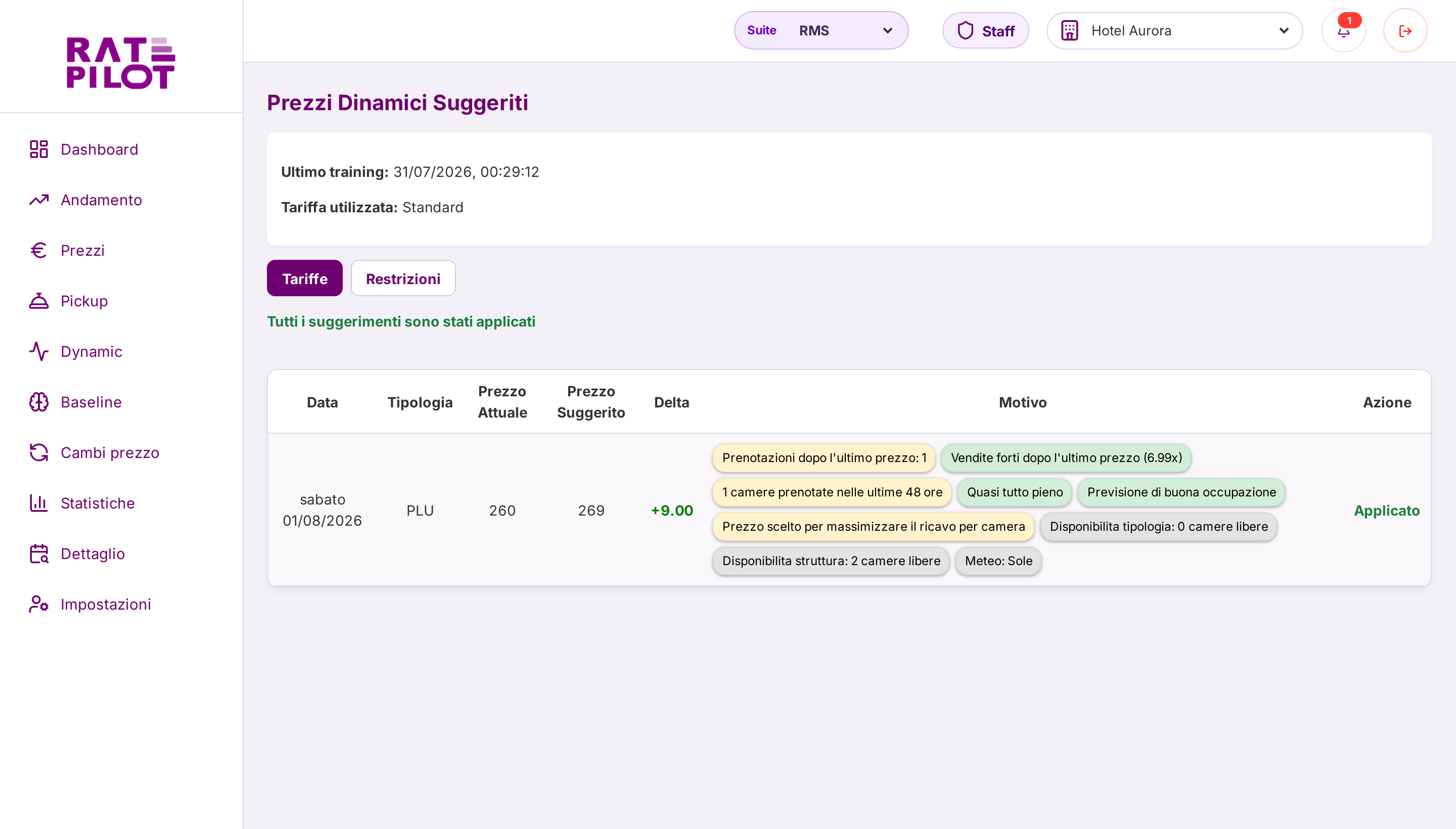
It is the fourth route: it reads occupancy and booking pace from the PMS and proposes a rate date by date, with why written next to it. Strong dates it prepares in advance, and weak days it does not forget.
Two things we say before anyone asks: we do not promise uplift percentages — anyone who does knows nothing about your property — and it connects to a PMS that is not ours, because replacing your PMS in order to do revenue management is a project you do not need. On a third-party PMS it works with fewer levers, though: it can only move the rules that system exposes, and some systems expose none.
It depends how many decisions a day you need to make. A system proposes prices every day on every date; a consultant brings the craft, the context of your market, and the ability to tell you that your strategy is wrong rather than your price.
If you have to choose with one budget, look at which problem you actually have: «I have no time to update prices» or «I do not know which strategy to follow».
We do not know, and anyone giving you a number does not know either. It depends how much margin is still on the table: a property selling everything at a flat rate in high season has a lot, one already working its peaks well has little.
What can be measured in a month is something else: how many times the price changed, on how many dates, and how much of your time it took.
For simple rules it is, and if you wrote them well they take work off you. What those modules generally do not do is compare the pace of incoming bookings with last year — and that is the signal you use to decide whether a date is ahead or behind.
If yours does it, keep it: you are already paying for it.
No, and bundling the two would be a bad idea. A pricing system needs to read bookings and availability: if your PMS exposes that data, it connects.
Replacing a PMS is a project of its own, with its own risks, and it should be taken on for its own reasons.
You do. A system that changes prices without telling you why becomes unmanageable the first day it gets one wrong, because you have no idea where to start correcting. The proposal has to be readable: this date, this price, for this reason.
The check-up measures five areas, and pricing is one of them. Sometimes the bigger margin is in another.
Take the check-up