
Hotel cancellation policy: how to write it so it holds up in a card dispute
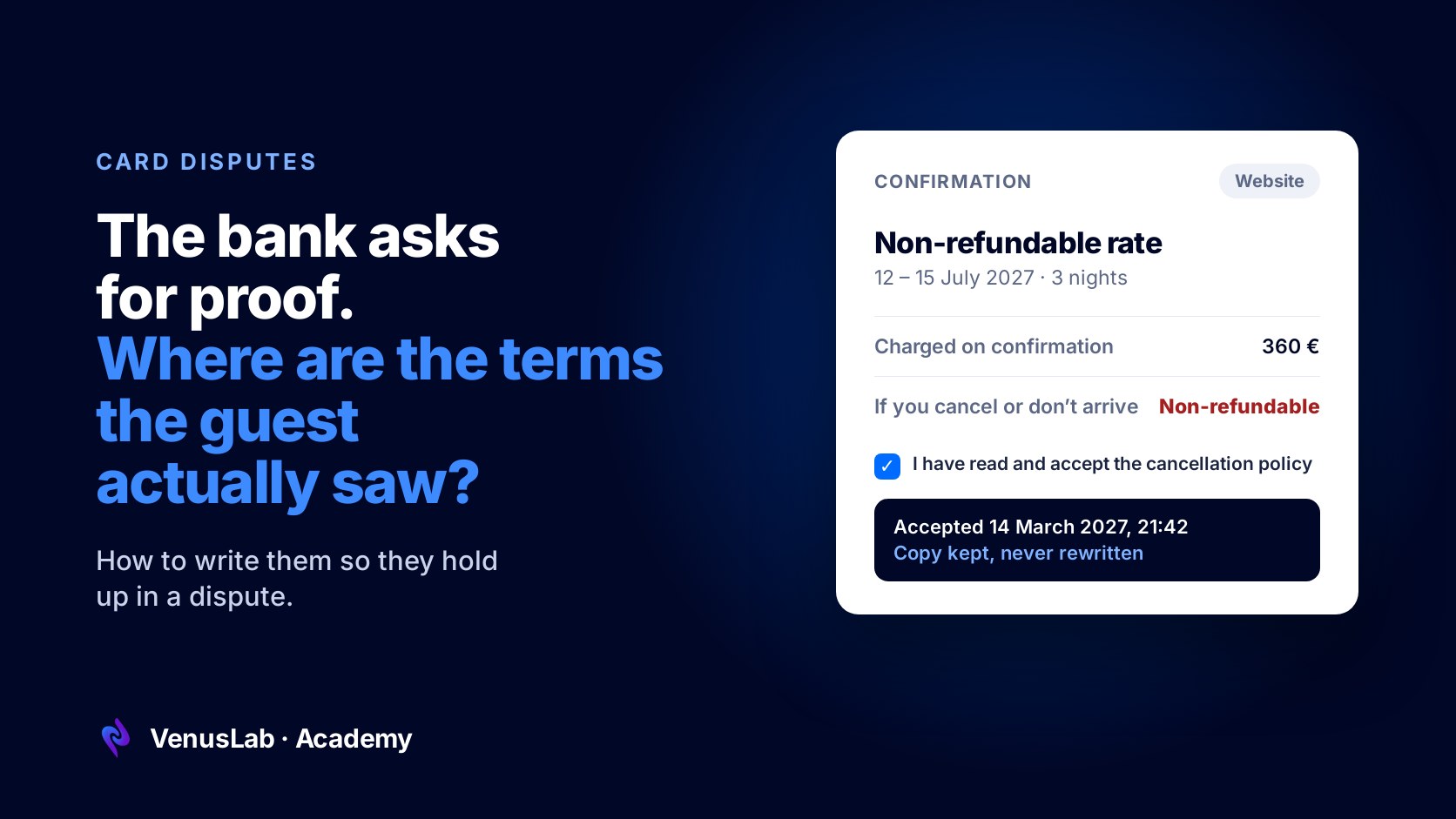
In March a guest books three nights in July on the hotel’s website, at the non-refundable rate. They pay straight away, because it is fifteen per cent cheaper. At the end of June they write to say they can no longer come and ask for their money back.
The front desk politely replies that the rate was non-refundable. A few weeks later the bank gets in touch: the guest has disputed the charge, and the hotel must prove that the terms were explained and accepted.
Someone opens the rates page on the website. But it was redesigned in May, and today the rate has a different name and a different penalty. The terms that count are the ones the guest saw in March, and nobody kept them.
What happens when a guest disputes a charge
The bank asks whoever took the money for proof
When a cardholder disputes a card payment, their bank passes the claim to the hotel’s bank. From that point it is the property that has to answer, with documents. If it does not answer, or answers badly, the money goes back to the guest.
Time is short. Visa warns that a missed deadline can lose the case even with good evidence, and Adyen, one of the large payment processors, indicates between nine and eighteen days to respond. The documents need to be ready beforehand, not searched for afterwards.
And the claim can arrive late.
A cardholder generally has 120 days from the payment to dispute it. For travel and services paid in advance the limit can stretch to 540 days. For a summer stay booked in spring, the case can open in autumn, when nobody remembers the phone call any more.
For disputes about cancelled services, Visa uses reason code 13.7. Its guide for merchants, updated in October 2026, says you can realistically respond only if you can show one of three things: the cancellation did not meet the disclosed terms, the charge was allowed by those terms, or the refund due has already been made.
And it repeats a simple rule: cancellation terms can be relied on only if they were disclosed before the purchase.
The fourteen-day withdrawal right does not apply
Many guests think they always have fourteen days to change their mind, as with any online purchase. For hotels it is not so. EU consumer law, which in Italy is article 59 of the Consumer Code, excludes the right of withdrawal for accommodation when the contract sets specific dates.
So what decides is the terms the hotel wrote, as long as they were disclosed beforehand and accepted. That is good news, but only if those terms can be shown exactly as they were on that day.
What changes when assistants book
On 17 November Vayo, the travel agent built by Booking Holdings, started booking trips for its first users, in an invitation-only trial. It books hotels through Booking.com and, where websites allow it, elsewhere too. The traveller approves every booking.
ChatGPT too, according to OpenAI’s documentation, can already visit a website on a user’s behalf and take actions for them. The numbers are small today. But the opening scene could come with a new line: “I didn’t choose the non-refundable rate, the assistant did.”
Visa, in its rules updated in October, says the cardholder is responsible for what the agent does as if they had acted themselves.
Citi argued in November that the company that built the agent should be responsible. OpenAI, in its documentation for businesses selling through ChatGPT, says that the order, customer support and fraud decisions stay with the business that sells.
For disputes that do not involve fraud, such as a badly chosen rate, there are no final rules yet. Both Worldpay, one of the large payment processors, and Markus Busch at hospitality.today say so. Until there is a rule, the claim takes the usual route: it goes to whoever charged the card.
The damage you don’t see
Terms change, proof doesn’t
Visa’s guide says it explicitly: if your policies change over time, keep the previous versions and the dates they became effective. In a dispute what generally counts is the version presented to the guest at the time of purchase, not today’s website.
In a hotel, terms change more often than it seems.
The website gets redesigned, a rate is renamed in the channel manager, the free cancellation window moves from seven to fourteen days for high season. Each change, on its own, makes sense. But each one makes it harder to prove what applied before, especially if nobody kept a dated copy of the old terms.
A label is not a term
The second mistake is subtler. The confirmation says “Flexible rate” or “Terms: Standard”, and the rest is “as per the terms published on our website”.
To whoever wrote it, it is crystal clear. To the guest, and to whoever examines a dispute, “Standard” says neither what happens nor when. For advance payments, Visa asks merchants to state the date and time when the right to a refund expires.
Rules that live only at the front desk
Then there is the exception made at the desk: the refund granted to a loyal guest, the penalty waived for someone who called the day after the deadline. These are sensible gestures.
But Visa warns that internal exceptions do not replace the terms disclosed to the guest. And it advises applying the rules the same way every time, noting each request and how it ended.
The same rate, three names
The third mistake comes from using different systems. The same rate is called “Non-refundable” on the website, “Prepaid” in the management system and “Saver” in the confirmation. Everyone working in the hotel knows they are the same thing, until they have to be placed side by side in front of someone who wasn’t there and has to decide who is right.
How to write terms that hold up
One sentence, with dates, time and amounts
The best term is one that can be understood in ten seconds, even by someone who wasn’t there. For example:
You can cancel free of charge until 23:59 on 10 July 2027, Italian time. After that date, or if you do not arrive, the first night is charged: 120 euros.
For a non-refundable rate the rule is even sharper. Under Visa’s rules on advance payments, the hotel can keep the full amount only if the receipt states that the payment is non-refundable. So the word has to be written out in full, not just in the rate name:
The full amount, 360 euros, is charged on confirmation. If you cancel, change dates or do not arrive, it is not refunded.
Then the sentence has to go in the right place.
In the confirmation the terms should sit next to the rate name and the dates. Not at the bottom, under the greetings and the parking directions, and not mixed into the general terms and conditions: Visa asks for them to be shown separately.
Whether a person or an assistant made the booking, whoever reads the confirmation should understand at once what was bought.
By phone and by email, the same sentence
Bookings taken by phone are the weakest. Terms said out loud leave no trace, and months later nobody remembers the exact words.
Visa allows the terms to be sent by email, text message or post. But the hotel must be able to prove the guest received and acknowledged them before or at the time of the booking.
So it pays to send the sentence with the terms straight away and ask the guest to reply with a simple “confirmed” before treating the booking as closed. The same goes for quotes sent by email: the terms belong in the quote, next to the price, not in an attachment.
Explicit acceptance, and a copy of it
On the website, Visa asks for the terms to be accepted with a checkbox or a button before payment, or shown next to the button that completes the purchase. A link to another page is fine only if it is part of the click to accept. Then three things need to be kept:
- the text of the terms as it was, not a link to today’s page
- the date and time of acceptance
- the amount the card could be charged, and when
If the terms change, existing bookings keep theirs. It is the same reason a signed contract is not rewritten.
What happens to the card, in plain words
Keeping the card details, blocking an amount and charging it straight away are three different things. Only one touches the guest’s account today. Saying so in plain words avoids surprises on the card statement, which are one of the shortest roads to a dispute.
The no-show penalty
For reservations guaranteed by card, Visa says to charge a no-show only if the guest did not cancel properly, and not for more than one night unless agreed. If the penalty is higher, the sentence in the terms must say so, with the amount.
A written reply to whoever cancels in time
Whoever cancels within the terms should receive a written cancellation confirmation, as Visa’s rules require. People who handle these cases also advise giving it a number. It protects the hotel too, because it fixes the moment of cancellation.
How we do it in OS
In VenusLab’s management system, a guest who books through the booking engine, or leaves a card as a guarantee, reads the cancellation terms and what happens to the card before confirming, and accepts them with a checkbox.
The system keeps a copy of the accepted text, with the date, the time and the internet address it was accepted from. That copy is never rewritten, even if the terms change later. And without a recorded acceptance, OS does not charge the penalty.
What to do this week
You don’t need new software. An hour and three real confirmations are enough.
- Take the last three confirmations you sent: one from the website, one by email, one by phone. Can the terms be understood in ten seconds? Does the non-refundable one actually say “non-refundable”?
- Rewrite each term as one sentence with date, time and amount. Out go “Standard”, “Flex” and “as per website”.
- Compare rate names on the website, in the management system, in the channel manager and in confirmations. Pick a single name for each.
- Test your booking engine on a phone: are the terms accepted with a checkbox before paying? Ask your provider whether it keeps the accepted text, with date and time, and for how long.
- Save a dated copy of the terms in force today, and do it again every time you change them.
- Decide who confirms cancellations in writing, with a cancellation number.
- Check your no-show penalty: if it is more than one night, it must be written in the terms.
Conclusions
A card dispute is not won by being right. It is won with documents: what was written, when the guest accepted it, how much could be charged.
Assistants that book on behalf of travellers do not change this rule. They only make it more frequent, because there is one more step between whoever chooses and whoever pays.
That is why it is worth fixing confirmations now, while bookings made by agents are still few. The same clear terms help with regular guests too.
Frequently asked questions
Can a guest withdraw from a hotel booking within fourteen days? No, if the booking has specific dates. EU consumer law, and in Italy article 59 of the Consumer Code, excludes the right of withdrawal for accommodation with a specific period of performance. The hotel’s cancellation terms apply.
What does the bank ask the hotel when a guest disputes a cancellation charge? To show that the cancellation did not meet the terms disclosed before the purchase, or that the charge was allowed by those terms. You need the text of the terms, the confirmation and proof of acceptance.
Is the cancellation policy page on the website enough? Usually not. What counts is the version the guest saw on the day of the booking. If the website has changed in the meantime, you need a dated copy of that version.
How do you write a clear cancellation term? In a single sentence, with the date and time until which the guest can cancel free of charge, the time zone and the amount charged afterwards. It goes at the top of the confirmation, next to the rate name.
If an AI assistant made the booking, who is responsible for the mistake? There is no final rule today. Visa attributes the agent’s actions to the cardholder, others argue the company that built the agent should answer. In the meantime the dispute goes to whoever took the money, that is the hotel.
What should be kept for each guaranteed booking? The text of the accepted terms, the date and time of acceptance, the type of guarantee and the amount that could be charged. For timely cancellations, the written confirmation with the cancellation number.
Does 3D Secure, the bank code at payment, protect against cancellation disputes? No. It shifts liability to the bank for fraud disputes, that is when the cardholder says they did not make the payment. For a disputed cancellation only the terms disclosed and accepted count.
Do you need new software to put your terms in order? No. Rewriting terms as one sentence, aligning rate names and saving a dated copy takes an hour. You can ask your current provider whether it keeps the accepted terms.
Note on sources. The rules on disputes for cancelled services (reason code 13.7), on disclosing terms online and by phone, on previous versions, on internal exceptions and on guaranteed reservations come from Visa, “Dispute Management Guide for Merchants” (October 2026). The rules on the non-refundable receipt, on the date and time the refund right expires and on written cancellation confirmations come from Visa, “Advance Payment Transactions” (2020). Dispute timeframes come from Adyen’s documentation and Chargebacks911; the cancellation number and time zone from Chargeflow, “Hotel no-show chargebacks”; 3D Secure from Chargebacks911 and Ravelin. The exclusion of the right of withdrawal is in article 59, letter n, of the Italian Consumer Code, which transposes EU Directive 2011/83. The news on Vayo comes from Booking Holdings’ announcement of 17 November 2026 and from Markus Busch at hospitality.today. The positions of Visa and Citi are summarised by Markus Busch, “Who pays when an AI agent books the wrong rate?” (Hospitality Net, November 2026); OpenAI’s from its documentation for businesses selling through ChatGPT (November 2026); the state of the rules for non-fraud disputes from Worldpay, “Agentic commerce liability is still being written”. The opening example is invented. This article is not legal advice.