
What to let AI do in a hotel: the rules to write before you switch it on
A guest writes the evening before departure: can they leave the room at two instead of eleven? The property’s assistant says yes, and the departure time changes in the management system. The guest is happy and the conversation ends.
The next morning, at a quarter past eleven, the room attendant knocks on the door. On the list printed at eight, that room is among the first to do. The guest explains that they were given permission, the head housekeeper calls the front desk, and meanwhile the room has been promised to a two o’clock arrival.
Nobody made a mistake, taken one by one. The yes reached the guest; the rest of the hotel never heard it. It is the most common case of a tool that only half works, and it says a lot about how any AI in a hotel should be chosen and switched on.
Saying yes to the guest is the easy part
What happens after that yes
The late checkout example is not ours. It comes from Shiji, which makes management systems for hotels and chains, in an article published this month on Hospitality Net. The list of consequences is long for such a small request.
- Housekeeping works from a list prepared in the morning and knocks at the usual time.
- The key card may expire at the old time, if nobody updates it.
- The room may be assigned to an arriving guest, without time to clean and inspect it.
- The porter or the transfer stay booked for midday.
Shiji sums up the problem in one simple sentence: updating the departure field does not, by itself, mean each of these things has been dealt with.
Why it is not a technology problem
The same mistake happens with people. The front desk grants a late checkout over the phone, writes a note, and the note stays at the front desk. Anyone who has worked in a hotel has seen it happen.
An automated tool does not create the problem: it makes it faster and more frequent. If late checkouts used to be granted twice a week, with an assistant answering everyone at night they can become ten. And each one brings the same round of phone calls.
Time is saved behind the scenes, and it stays there
What the American survey says
On 4 November the American Hotel & Lodging Association, AHLA, published a report with Actabl on AI and the hotel workforce. Nine respondents in ten say AI helps routine work get done faster. 84% say it has improved their own work.
But only 15% say it has improved the work of people who deal with guests. The report itself points to frontline work as the next opportunity, because today the benefits are seen mostly by those who plan and decide.
What it means in a hotel
The figure is American, but the mechanism is the same everywhere. The tool does the part you can see on screen well: it answers, fills in, updates. The work of the front desk, housekeeping and the kitchen depends instead on what happens next.
If the tool’s decision does not reach the people who have to act on it, the time saved in the office is spent again in the corridor. The useful question is where the tool’s work ends up.
The question almost nobody asks
HFTP’s five questions
HFTP is the international association of hospitality finance and technology professionals. Its head of communications, Robert Firpo-Cappello, set out five questions to ask before buying an AI tool.
- What business problem does it solve, and how will we measure it?
- Is our data ready?
- Who owns the data, and who owns what the tool produces?
- What new security and privacy risks are we taking on?
- Who is accountable when it gets it wrong?
Who is accountable when it gets it wrong
The first four are often asked, at least in part. The fifth almost never, because people assume it can be sorted out later, once the mistake has already reached the guest.
For HFTP, answering it means knowing where people stay in the loop, who reviews what the tool does and which internal policies apply. In day-to-day terms, it means deciding in advance, action by action, how far the tool can go on its own.
Three columns for every action
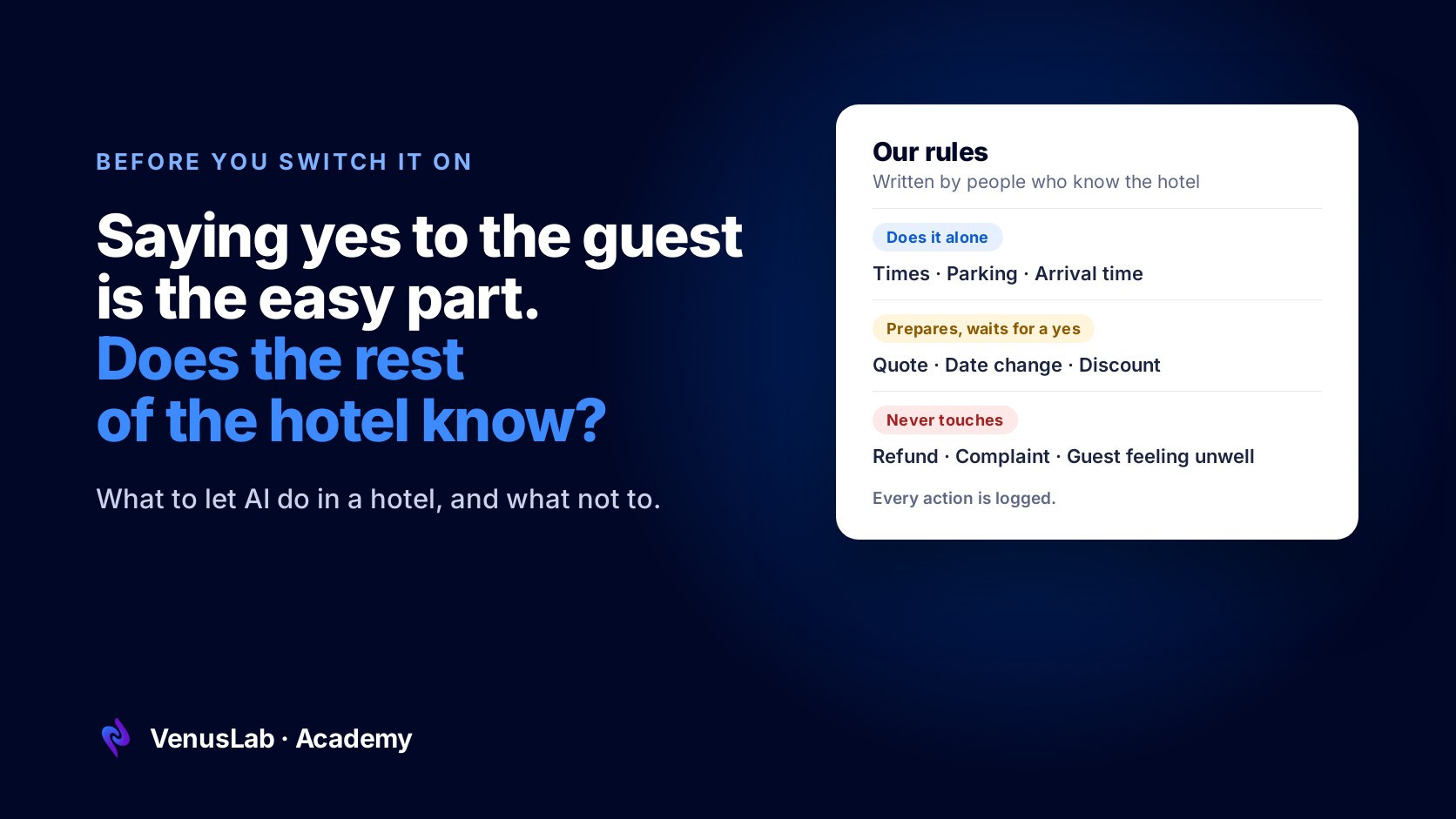
The simplest way to answer the fifth question is a sheet with three columns. Everything the tool might do goes into one of the three. It is written by someone who knows the hotel, not by whoever sells the tool.
What it does alone
This column holds actions that do not change money, rooms or commitments made to the guest. Answering about check-in time, sending parking directions, noting on the booking that the guest will arrive around six.
The practical test is simple: if it gets it wrong, an apology fixes it and nobody loses anything.
What it prepares and leaves for a yes
This column holds actions that touch the bill, availability or a promise. A quote, a change of dates, a discount, a paid late checkout. The tool does all the preparation and stops before the last step.
A person reads it over and confirms with one tap. Time is still saved, because the long part of the work is the preparation, not the yes.
What it never touches
This column holds things that need a person from the start. A refund, a complaint, a guest who had a problem in the room, a guest who is unwell.
The tool can notice them and hand the conversation over, with a summary of what happened. It does not answer on the substance, even if it could.
Everything stays on record
Under the three columns sits one rule that applies to all of them: every action leaves a readable trace. What was done, when, on which booking, with which message.
It is not about mistrust. When the tool gets something wrong, and sooner or later it will, you need to know what to put right and whom to apologise to.
An example: invoice requests
The perfect boring job
Martin Soler, a hotel marketing consultant, wrote this month that he has changed his mind about AI agents. Among his examples is the invoice request a guest sends by email.
The agent he describes reads the inbox, identifies the guest, finds the stay in the management system, prepares the invoice and drafts the reply. If it cannot find the booking, it asks the guest for the details needed to look it up.
How it splits across the three columns
In Italy the case is even more typical. Guests write weeks later, with a VAT number, an e-invoicing recipient code and a company name that does not match the name on the booking. Someone has to find the stay and check every detail.
- Alone: reading the request, finding the stay, asking the guest for missing details.
- Prepares and leaves for a yes: the completed invoice, ready to issue, with the details checked against each other.
- Never alone: issuing it, and any correction to a document already issued.
Soler himself insists that agents need supervising. In his examples, when the agent is unsure it puts the case in a review queue, and it changes room assignments only after approval.
An example: a late checkout done properly
What has to reach whom
Back to the two o’clock room: a late checkout done properly is the same yes, except that it reaches everyone who works after it.
- Housekeeping sees “leaves at 2pm” on the room’s line, and finds it at the end of the order, not among the first.
- Whoever assigns rooms is warned if they put a guest arriving before two into that room.
- The front desk finds it in the day’s movements, without hunting for a note.
- The key and services, if the hotel has connected locks or transfers, need moving too.
How Ambra does it
To take Ambra, the AI receptionist we build, as an example, a late checkout follows the three columns. If the property has allowed it and the late checkout is free and within the written rules, Ambra records it on the booking in the management system, and from there it reaches housekeeping, whoever assigns rooms and the front desk.
If it is paid, Ambra prepares it and a person confirms it after checking the bill. The reply to the guest goes out only once the management system has recorded the change. And the permission stays off until the property decides to turn it on.
The columns move over time
The three columns are not the same for every hotel. A 25-room hotel with the owner always at the desk can leave a lot in the yes column, because someone confirms within minutes. A group with rotating shifts needs more detailed written rules, because the person confirming changes every shift.
They change within the same hotel too. You start cautious and move an action from one column to another once you have seen it work for a few weeks, reading the record. Trust is built on the hotel’s own real cases.
What to do this week
You do not need to change software. You need an hour with the front desk team and the head housekeeper.
- List the requests that come in most often by email, WhatsApp and phone. Starting with the top twenty is enough.
- Choose a column for each: alone, prepares and leaves for a yes, never. If there is disagreement, put it in the more cautious column.
- Write next to it who needs to know afterwards. The late checkout goes to housekeeping, the cot to housekeeping, the allergy to the kitchen, the parking to whoever manages the spaces.
- Check whether that information really gets there today, even when a person handles it. That is where it most often gets lost.
- Take the sheet to your supplier, current or future. Ask whether the tool respects the three columns, where the record is kept and who is notified after each action.
Conclusions
An assistant that answers the guest well has done the easy part of the job. The service is complete when the decision has reached the people who have to act on it: housekeeping, the kitchen, whoever assigns rooms.
That is why the question to ask before switching on any tool is the one asked least: who is accountable when it gets it wrong. The answer is a sheet with three columns, written by people who know the hotel, and a record that makes it possible to put things right.
The rest comes later. An action moves into the column of things the tool does alone once you have seen it work well, one at a time.
Frequently asked questions
What does it mean that an automated tool only half works? It means it answers the guest and updates a field in the management system, but the decision does not reach the departments that have to act. The typical case is a late checkout granted by chat that housekeeping knows nothing about.
Which tasks is it worth letting AI do alone in a hotel? Those that do not change money, rooms or commitments made to the guest: information about times, parking and services, acknowledgements, notes on the booking such as arrival time.
What does it mean that the tool prepares and leaves it for a yes? It does all the work, for instance it fills in a quote or an invoice, and stops before sending or issuing it. A person reads it over and confirms. It is used for anything that touches the bill, availability or a promise to the guest.
What should AI never do alone in a hotel? Handle refunds, complaints, problems in the room, a guest who is unwell. It can recognise them and pass them straight to a person with a summary, but it should not answer on the substance.
Who is responsible when AI gets it wrong? Legal responsibility also depends on the contract with the supplier. In practice, though, the guest sees the mistake and the property has to fix it. That is why the rules should be written in advance, action by action, and every action should leave a readable record that shows what happened and allows it to be put right.
Are the rules the same for every hotel? No. They depend on size, on who is at the desk and on how much the tool is trusted. It is best to start cautious and move an action towards autonomy only after seeing it work for a few weeks.
Do I need new tools to get started? No. The three-column sheet and the list of who needs to know what can be done with the staff in an hour. They are also useful for checking whether information reaches the departments when people are the ones handling it.
A note on sources. The late checkout example and its consequences for housekeeping, keys, room assignment and services come from Shiji, “What Happens When Hotel Automation Only Half Works?” (Hospitality Net, November 2026). The figures on AI and the workforce come from the AHLA and Actabl report “AI and the Hotel Workforce”, released on 4 November 2026 and reported by Hospitality Net and MarketScale. The five questions are by Robert Firpo-Cappello, HFTP, “AI Questions Every Hotelier Should Be Asking” (Hospitality Net, November 2026). The invoice request example is by Martin Soler, “I Think I Was Wrong About Agents” (Hospitality Net, November 2026); the adaptation to the Italian case is ours.